Buying guide for best sea scooters
Ready to buy now? Shop the best:
Some call it the closest experience you can have to flying. It's a leisurely activity that is absolutely invigorating, providing all the thrills of a daredevil pursuit without the risk. If you'd like to partake in an adventure that is truly like no other, gliding effortlessly through the water, you may want to consider purchasing a sea scooter.
The best sea scooter is lightweight and easily portable. It has a reliable, long-lasting battery and fits within your budget. If you enjoy documenting your underwater excursions, your sea scooter needs to have a camera mount so you can shoot those breathtaking underwater videos.
Our top choice is the travel-friendly Sublue Mix Pro Dual Motor Underwater Scooter, which boasts a one-hour battery life and is waterproof up to 131 feet.
Editors' picks
Weight: 7.8 lb | Top Speed: 4.03 mph | Battery Life: 20 min continuous high speed, 30 min continuous low speed
The Sublue Mix Pro Dual Motor Underwater Scooter reads like a real underwater scooter rather than a novelty, and we think that matters if you want something for snorkeling, casual diving or free diving. Its dual motors deliver 24.25 lbf of thrust, and the two speed settings give you a practical range rather than just one fixed pace.
The top speed is 4.03 miles per hour, which is quick enough to move you efficiently through the water without feeling like a high-adrenaline speed machine. At 7.82 pounds with the battery installed, it's still manageable to carry. On top of that, the positive buoyancy design is especially reassuring: If you let it go, it floats back up instead of drifting away or sinking out of reach.
Overall, if you want a compact underwater scooter that prioritizes portability, safety and dependable performance over raw speed or marathon battery life, the Sublue Mix Pro is a strong fit.
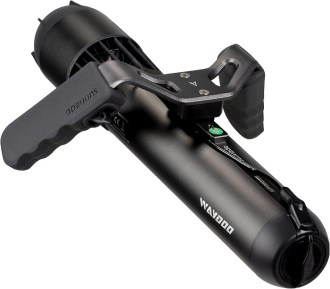
Weight: 3 Ib | Battery Life: Cruise mode up to 56 min
The Waydoo Subnado Underwater Scooter is built for people who want an underwater scooter that's easy to carry, pack and use. At 14.84 by 2.76 by 2.76 inches and about 3 pounds, it's compact enough to bring along without much hassle.
The airline-approved 98Wh battery is a big plus if you want something you can actually fly with. And with 100-watt fast charging, a full charge takes about 1.2 hours, which is much easier to manage than waiting most of a day. The tradeoff is simple: This battery is better for short outings and repeat sessions than for long days on the water.
Overall, it's a solid pick if you care more about convenience, portability and versatility than maximum runtime or heavy-duty power. The aluminum-alloy housing, detachable finger safeguard, included safety guard, arm mounts and handgrip show that Waydoo put real thought into safer, easier handling for adults and kids alike.
Weight: 5.5 Ib | Battery Life: Up to 70 min
The LEFEET Underwater Scooter S1 Pro is compact, made of aluminum and designed to do more than just float. At 5.5 pounds, it should be fairly easy to pack and carry.
The modular design is a real plus if you want one device for snorkeling, swimming, freediving or diving. We also like the wireless control and the airline-friendly design. The tradeoff is that modular gear usually means more parts and more setup, so it may take a little getting used to.
The three speed settings and top speed of 6.5 kilometers per hour give you a good range, from a relaxed cruise to a faster boost when needed. We also like the included action camera mount, which makes underwater filming easier.
Overall, the S1 Pro is a well-rounded, portable underwater scooter with useful power, solid depth potential, and smart features.
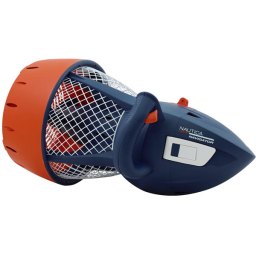
Weight: 11.4 Ib (with battery) | Top Speed: 2.5 mph | Battery Life: 60 min
The Nautica Navigator is a good choice for younger snorkelers and recreational divers who want an easy boost in the water. With a top speed of up to 2.5 miles per hour and a maximum depth rating of 30 feet, we see this more as a pool and shallow-water scooter than gear for serious diving. The plastic build should keep it light and manageable for family use, and the blue-and-orange colorway makes it bright and easy to spot in the water.
The rechargeable marine battery is rated for up to 60 minutes of runtime, which should be enough for a solid outing. However, the 7- to 8-hour charge time means you’ll want to plan ahead if you expect multiple sessions.
If you want a straightforward, camera-ready sea scooter for shallow-water play and casual exploration, this Nautica model is a solid pick.
Weight: 7.7 Ib | Top Speed: 3..35 mph | Battery Life: 35 minutes
The Asiwo Underwater Scooter features dual 600-watt motors, 9 kilograms of thrust, a self-floating body, a child-safety lock, a protective net, an action camera mount and one-hand mode.
It's built to be easier to control, less likely to sink away if you let go, and more useful if you want to film underwater. The included battery, carry bag, charger and adapter also make it feel like a complete kit instead of a bare-bones accessory. Past that, we like that the FOC motor control is meant to keep the operation quieter and smoother, since that usually makes an underwater scooter feel less jerky and easier for newer users to handle.
There are a few limits to keep in mind, though: the battery life is only a little over half an hour, and the one-year warranty on the main unit and six months on accessories is fair, but not especially generous.
Overall, if you want an approachable underwater scooter with useful safety features, camera support and a fairly complete package, this is a strong option.
Key considerations
Safety
Safety should always come first, especially when you're underwater, where reaction time can be limited. A well-designed sea scooter can add to your safety, but only if it includes the right features. Look for models with fully enclosed propellers to help prevent accidental contact with moving blades. This is particularly important if children will be using the scooter or if you're sharing the water with others.
An automatic shutoff function is also essential. If you let go of the throttle, the scooter should stop immediately to avoid drifting away or continuing without control. Many modern scooters, come equipped with dual-trigger controls and child safety locks to prevent accidental activation. Protective grilles around the rotors are another important feature, offering an added layer of security to keep fingers and hands safe.
Intended use
Beyond safety, the most important aspect of purchasing a sea scooter is knowing how you intend to use it. Do you just want a fun toy to play with in a swimming pool? That’s a very different sea scooter than one that can descend over 100 feet.
After you've decided where and how your sea scooter will be used, move on to the next section to see a list of potential features so you can decide which ones you want your model to have.
Features
Maximum depth
If you're planning to stay near the surface or cruise around a swimming pool, most sea scooters will suit your needs just fine. However, if you're interested in diving beyond 15 feet, you'll need a model designed for greater depth. Not all scooters are built to handle the increased water pressure that comes with deeper dives, so it’s important to check the depth rating before making a purchase.
For beginners, it's important to approach deeper diving with caution. Using a scooter that can descend to significant depths without proper training can increase the risk of injury. Professional instruction is recommended to learn how to manage pressure changes, equalize properly and safely return to the surface. A deeper-rated scooter can be a great tool for experienced divers, but it should be used with the right knowledge and preparation.
Charging time and battery life
There are two factors to consider regarding the battery. The first is charging time. If you’re not a planner and tend to do things at the last minute, you will likely need a battery that can charge relatively quickly. If you like to map out your adventures in advance, however, a lengthy charging time may not be a big deal to you.
The second factor, battery life, is crucial. In the best-case scenario, if your battery runs out of juice, it will simply bring an end to your festivities. In the worst-case scenario, it could leave you stranded. Think about what you want to do with your sea scooter. Then, find a model with the features — including battery life — that will allow you to comfortably do that.
Note that advertised battery times are for optimal conditions. If you're cruising around at top speed and carrying a lot of gear, you might only get half of the stated battery life.
Buoyancy
Ideally, your sea scooter would give you some control over buoyancy. But most models don’t have that feature, so you'll need to compromise. The less buoyant a model is, the easier it will sink, which can be good if you’re doing deep dives. However, if you’ll be staying near the surface, you will want a sea scooter that’s buoyant enough to keep you there.
Speed
Most recreational sea scooters travel at relatively modest speeds, typically around 2 to 4 miles per hour. This is fast enough to enjoy a sense of movement without feeling out of control, especially in pools or shallow water. If you're not looking for a racing machine, this range will be more than enough for casual exploring.
For added flexibility, consider choosing a model with multiple speed settings. This allows you to slow down when you want to take in your surroundings or conserve battery life and speed up when you need to cover more distance. Adjustable speeds can also make the scooter more enjoyable for users of different ages and comfort levels.
Camera mount
Chances are good that you want the ability to take underwater photos and videos on your sea scooter. In that case, you'll want a model with a camera mount.
Weight
The weight of your sea scooter shouldn't be too much of an issue while it’s in the water (unless your battery dies and you have to drag it back to shore). When you’re carrying your sea scooter on land, however, you will appreciate a lighter model. Just don't make the mistake of going too far and sacrificing durability for a lighter weight.
Color and design
Many sea scooters look similar, with the only distinctions being small variances in shape and color. Unfortunately, in order to get a model that does everything you want it to, you may have to settle for a color that’s not your favorite.
Additionally, at the higher end of the price spectrum, you will find models with drastically different designs. The key is to get the features you need without getting too hung up on style.
Sea scooter prices
Sea scooters range in price from just over $200 to $1,500. The main differences in models are the maximum depth and maximum speed the units can reach.
Inexpensive
In the $200 to $300 range, you can expect to travel around 2 miles per hour for about an hour (under optimum conditions) and go 15 to 30 feet deep.
Mid-range
When you move up to the $300 to $500 range, the models may run a little longer, and they can travel at least twice as deep. Most still won't reach speeds greater than 3 miles per hour.
Expensive
Once you get to the realm of sea scooters that cost $500 and up, you can find machines that reach a depth of 100 feet or more. At the upper end, you may find models that run for close to two hours (under optimum conditions) and reach speeds of 6 miles per hour or greater.
Tips
Although sea scooters are designed to be safe and easy to use, there are a number of factors to keep in mind to prevent unfortunate incidents from occurring. Here are some of the most important safety tips.
- Inspect your sea scooter before every outing. The fact that it worked last time doesn't mean it will work this time.
- Replace old batteries. Batteries tend to last about four years. Pay attention to a battery that starts to lose its charge quickly so you don't get stranded halfway through your adventure.
- Use the buddy system. Never venture out into the water alone, and never travel out of sight of your buddy.
- Know your environment. Be aware of other divers, boats, potential hazards, seaweed and marine life.
- Remember how to descend and ascend. A sea scooter makes it easy to break the rules accidentally; do not forget your training.
- Don't push your limits. Know what you are capable of, and stay well within those parameters.
How we analyzed
There are many factors to consider when comparing sea scooters. Some are purpose-built for specific activities; others lean toward the recreational side. That said, we looked at some universal elements to determine which sea scooters are the best overall.
We examined data for close to 20 sea scooters. To arrive at our top selections, we considered maximum speed, thrust, depth rating and battery life. Other important factors that contribute to an excellent experience include any mounts for accessories (such as action cameras), how long the battery takes to recharge, ease of operation and how much effort is required to keep the sea scooter steady underwater.
FAQ
Q. Who might want to use a sea scooter?
A. Divers, snorkelers and swimmers can all enjoy sea scooters. The purpose isn't fast joyriding; a scooter allows you to travel through water without fatiguing so you can better enjoy your activity. It also lets you travel with more gear than you would be able to comfortably carry without the device. Sea scooters can also be used by rescue divers to help broaden their scope of coverage.
Q. How do I steer a sea scooter?
A. Steering a sea scooter is easy. In fact, it may be a little too easy for beginners. All it takes is a slight shift of your body weight (comparable to leaning) to steer. It’s best practice to get some professional sea scooter training before you do anything too advanced with your sea scooter.
Q. How should I store my sea scooter if I will not be using it for an extended period?
A. Before putting your sea scooter away, give it a thorough inspection to make sure everything is in optimum working condition with no visible problems, such as damage or leaks. Then, give the unit a good cleaning to remove any lingering salt or chemicals.
After drying it, store your sea scooter in a cool, dry place away from heat and direct sunlight. Every two to three months, give the battery a charge, or put the battery on a trickle charger so it will be ready to use when you need it next.
Q. Could I outrun a shark on a sea scooter?
A. Definitely not. A great white shark can swim about 25 miles per hour. Most sea scooters don’t go faster than 4 or 6 miles per hour.