Buying guide for best juicers
Ready to buy now? Shop the best:
As embarrassing as it is to admit, I have the eating habits of a five-year-old when it comes to vegetables. While there are a few I enjoy eating — carrots and spinach top my list — the texture and flavor of most just turn me off, no matter how they're cooked. I am better about eating fruit, but I know I could do better there, too.
That's why my juicer has made such a difference in my diet. Fresh, homemade juice is a great way to incorporate more fruits and vegetables every day, especially if you're like me, and texture can be an issue. But if you want to make fresh juice yourself, you need a high-quality juicer to get the job done. It's specially designed to extract liquid from fruits and vegetables so that you get a smooth, nutrition-packed drink for less than what you’d pay at the juice bar.
Choosing a juicer can be tricky, though. Your first decision is whether you want a centrifugal (or extracting) juicer or a masticating juicer, which works more slowly than a centrifugal model but arguably creates a more flavorful beverage. Other features can make one model a better fit for your kitchen than another, so you should consider things like the types of fruits and veggies you like to juice and how much space you have.
At BestReviews, we've researched and evaluated over a dozen juicers to find the best models. Our top pick, the Nama J2 Cold Press Juicer, makes juicing easier with a self-feeding hopper that cuts the produce for you and quick-release parts that make cleaning a breeze. It's also backed by a 15-year warranty, so you can trust that it's built to last.
Expert tip
Don’t forget to use the extra pulp. The pulp contains fiber, which is what can slow down digestion and make us feel fuller longer. Try adding the pulp to a smoothie, make “juice pulp” bread or bars, or add it to soups.
BestReviews Nutrition Expert
Editors' picks
NAMA J2 Cold Press Juicer
Editors' Favorite
Type: Masticating | Dimensions: 11.6" D x 9.8" W x 9" H | Capacity: 70 oz | Weight: 12.1 lb | Power: 200 W
The Nama J2 Cold Press Juicer is, in our opinion, the best overall cold press juicer available, making it our Editor’s Choice. While somewhat pricey, it excels at producing the best cold-pressed juice with outstanding extraction efficiency and does so with minimal effort from you.
The Nama J2 has a 200-watt motor that runs its auger at 50 rpm, minimizing any friction or heat that could affect the juice’s flavor and nutritional quality. Its 70-ounce hopper holds a large quantity of fruit or vegetables, allowing you to fill it up and start juicing without having to pay it any more attention or feed it produce one piece at a time. Its extraction efficiency often results in nearly dry pulp, minimizing food waste.
However, the J2 isn’t limited to just juice. With attachments it can be made to produce nut milk, grain milk, smoothies and soups. It comes with all the necessary accessories and a cleaning brush.
Elite Gourmet Juicer
Best Citrus Juicer
Type: Centrifugal | Dimensions: 7.28"D x 5.71"W x 7.68"H | Capacity: 24 oz | Weight: 1.5 lb | Power: 40 watts
Our picks concentrate on all-around juicers that turn any piece of produce, fruit or vegetable, into juice. But sometimes what you really want is a machine that gets juice out of oranges, lemons, limes and grapefruit. For that, you need a machine like the Elite Gourmet Electric Citrus Juicer.
The Elite Gourmet Electric Citrus Juicer does just one thing, but does it well. It has a 40-watt motor driving its central reamer cone. Juice, but not pulp, runs through its collector-filter into the 24-ounce BPA-free plastic pitcher, ready to serve. The reamer and motor auto-reverse, extracting the maximum amount of juice from the citrus pith. A convenient cover protects the reamer cone when not in use.
The Elite Gourmet citrus juicer is compact and lightweight, making it relatively unobtrusive on the counter and manageable to store. Plus, it’s available at a price close to pocket change, so it’s ideal for those on a budget.
Magic Bullet Mini Juicer
Best for its Compact Footprint
Type: Centrifugal | Dimensions: 7" D x 6" W x 11.5" H | Capacity: 17 oz | Weight: 4.5 lb | Power: 400 W
For a fast and simple juicer that blazes through fruits and vegetables, we suggest the Magic Bullet Mini Juicer. It’s a compact, powerful device that we think is notably easy to use.
The Magic Bullet Mini Juicer is a 400-watt centrifugal juicer with a 17-ounce capacity. It has a 2-inch feed chute for dropping in cut-up apples, carrots, celery or bunches of spinach. It comes with a 16-ounce cup that’s ready to drink from if you want the freshest juice possible, or cover it up with an included lid and take your juice with you on the go.
At less than a foot tall and about 7 by 6 inches square, it’s more compact than other juicers, easy enough to leave on the counter for convenience. It comes with a feeder pusher and a brush for cleaning.
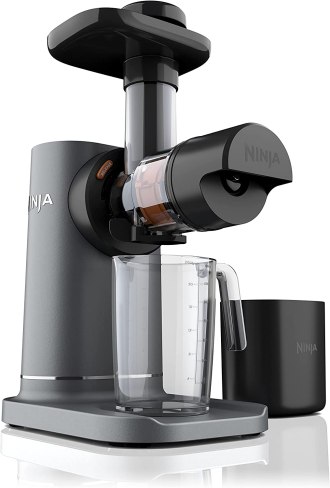
Ninja JC151 NeverClog Cold Press Juicer Gen 2
Trusted Brand
Type: Masticating | Dimensions: 12.11" D x 7.15" W x 15.93" H | Capacity: 24 oz | Weight: 7.93 lb | Power: 150 W
The Ninja NeverClog Cold Press Juicer is a streamlined, updated model we think would be a great everyday machine for those new to juicing. It’s easy to set up, has dishwasher-safe parts and boasts innovative pulp control features.
The 150-watt Ninja horizontal masticating juicer has a tall feed chute and a sleek but capacious juice jug and pulp container. Its “never clog” system boasts the ability to clear pulp by pushing it through the filter, making the appliance easier to clean.
The Ninja comes with two different filters so you can decide if you want a little pulp in your juice or not.
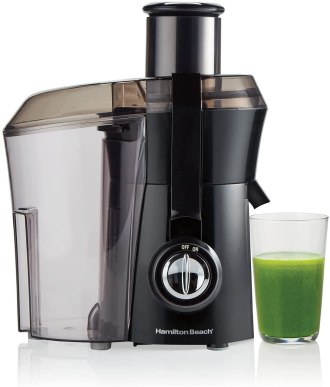
Best Under $100
Type: Centrifugal | Dimensions: 11.5" D x 7.8" W x 14.4" H | Capacity: 80 oz | Weight: 5 lb | Power: 800 W
A customer favorite, the Hamilton Beach Big Mouth Pro Centrifugal Juice Extractor wins kudos for its extremely affordable price. The Big Mouth’s powerful 800-watt motor easily crushes fruits and vegetables and turns them into juice in minutes.
The large 80-ounce pulp bin means you don’t have to stop and empty it as often. According to Hamilton Beach, the pulp bin can handle up to 25 apples before needing to be emptied. This model also includes a nice 3-inch-wide feed tube for whole apples or peeled lemons.
However, it doesn’t come with a separate juice cup, so you’ll need to supply a glass or other container. But given how affordable this model is, that shouldn’t be a deal breaker. It also comes with a three-year limited warranty for peace of mind.
Breville Juice Fountain Plus
Best Centrifugal Juicer
Type: Centrifugal | Dimensions: 14.09" D x 12.6" W x 16.42" H | Capacity: 35.2 oz | Weight: 10.1 lb | Power: 850 W
The Breville Juice Fountain Plus is the best overall centrifugal juicer in our opinion, with a simple control system and easy-to-understand design that doesn’t skimp on power.
The Juice Fountain Plus runs on an 850-watt motor to power through tough produce like carrots and celery, while still processing softer items like spinach and citrus. A simple toggle switch is all that’s needed to go from low to off to high power.
It has a 3-inch feed chute, suitable for whole small fruits, while a titanium-reinforced shredding disk and steel mesh process its contents. Its 1.1-quart juice jug also includes froth separation, so more juice ends up in your glass.
The Juice Fountain Plus comes with several safety features, including an arm that ensures it can’t be operated without its cover in place, and an LED indicator that lights up when it’s overloaded. Its power cord wraps neatly inside it as well for storage.
Hurom H400 Easy Clean Slow Juicer
Quiet & Easy to Clean
Type: Masticating | Dimensions: 10.3" D x 6.6" W x 18.5" H | Capacity: 18.6 oz | Weight: 22.6 lb | Power: 150 W
A top-of-the-line entry from Hurom, the brand that pioneered juicers in the 1970s, the Hurom H400 Easy Clean Slow Juicer improves upon the H200 model with an even sleeker appearance, a slightly larger capacity and more RPM.
It runs on a 150-watt motor, with a two-part auger in its Easy Clean chamber running at 90 rpm, faster than the 50 rpm of the H200. Its self-feeding hopper has a 550-milliliter or 18.6-ounce capacity that sits almost flush with the rest of the unit, which also includes an internal pulp bin, keeping your counter neat and tidy.
Another perk is that the Easy Clean chamber containing the auger doesn’t use a strainer; instead, it uses the two-part auger’s meshing design to filter out pulp. This makes it easier to take apart and clean than other juicers. Its 150-watt motor is also quiet compared to those that drive other juicers.
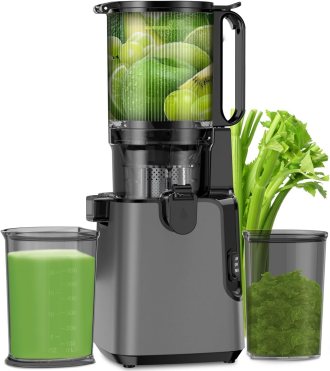
YPONE Juicer Machine
Useful Features
Type: Masticating | Dimensions: 13.2" D x 7.2" W x 16.8" H | Capacity: 30 oz | Weight: 9.83 lb | Power: 350 W
Another low-cost option, the YPONE Juicer provides the look and design of expensive masticating juicers in a unit that can be purchased for much less, while still offering the same useful features.
This masticating juicer has a 350-watt motor and runs at 55 rpm, slow enough not to generate unwanted heat. It has a double layer of mesh with 0.7- and 0.3-millimeter holes to strain out pulp and fiber, which it expels into a tapered external bin that matches its juice vessel.
Its auger cuts as well as grinds to process fruits and vegetables. A generously sized 5.8-inch feed chute can hold whole pieces of produce if desired and saves time over feeding smaller pieces one by one.
With three main parts, this juicer can be quickly taken apart for cleaning, and comes with a cleaning rod and brush.
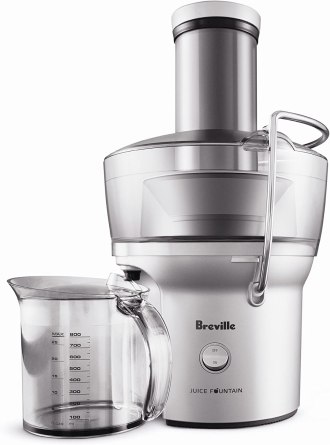
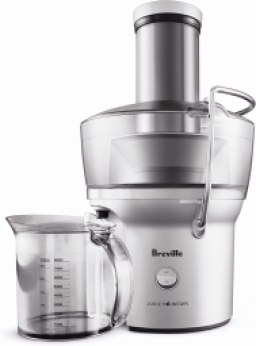
Breville BJE200XL Juice Fountain Compact Centrifugal Juicer
Tested Choice
Type: Centrifugal | Dimensions: 9.8" D x 9" W x 15.75" H | Capacity: 18.6 oz | Weight: 22.6 lb | Power: 150 W
If speed is important to you, we recommend the Breville Juice Fountain Compact, which impressed us when we evaluated it in our Testing Lab. This is a centrifugal juicer with a 700-watt motor that spins a juicing grate at 14,000 revolutions per minute.
The Breville saves space by keeping the pulp inside the mechanism rather than pushing it into a separate container, while its 3-inch-wide chute lets you juice smaller foods whole without having to cut them up first.
We also like the built-in froth separator on the juice jug, reducing the foam that centrifugal juicers produce. “It created a great consistency of juice that had very little pulp and no chunks leftover,” our tester said. “I enjoyed the froth separator and thought this was a unique perk of using this juicer over others.”
Expert tip
For an easier clean-up experience, I recommend washing the juicer or leaving it to soak immediately after use. Leaving it out with pulp and juice residue inside will make the machine stickier and harder to scrub.
BestReviews Nutrition Expert
How we tested
After researching juicers to find the very best, we checked out the Breville Juice Fountain Compact in our Testing Lab to see how it performed.
Setup
- Size: We noted the footprint of the juicer as well as its height to see how it fit not only while in use but also when stored away.
- Design: We judged the juicer on its design, such as spout placement and pulp disposal, for both looks and practicality.
- Ease of assembly: Putting a juicer together can be complicated. We noted how easy it was to assemble the juicer the first time and reassemble it after cleaning.
Usage
- Feed chute: We tested how easy it was to feed various foods via the juicer’s food chute, noting length, width and platform, if any.
- Food handling: We paid attention to how well the juicer handled various kinds of produce, such as soft fruits, firm fruits, citrus, crunchy vegetables and leafy vegetables.
- Accessories: We kept track of any included accessories, such as pulp jars, juice jars, cleaning implements and extra attachments.
- Noise: We took note of how loud the juicer was while operating, comparing models and juicer types.
Results
- Juice quality: We evaluated the juice produced for taste as well as color, texture and impurities including foam or froth.
- Pulp: We noted the amount of pulp generated by the juicer, how wet or dry it was, how much of it ended up in the juice and the ability to control the amount of pulp included in the juice.
- Cleanup: We rated the juicer on ease of cleanup, including how long the process takes and how simple or difficult it is to disassemble. We noted which parts are dishwasher safe and which are better cleaned by hand, including any included brushes or tools.
Expert tip
Our bodies are roughly 55-60% water, so they require a lot of hydrating. Juicing can be a tasty and nutritious way to help keep us hydrated, especially if we struggle to drink plain water.
BestReviews Nutrition Expert
What to know before you buy a juicer
Types
Centrifugal: Also called extracting juicers, these juicers have a spinning mesh wheel with a grate. As produce is whirled against the grate, it is shredded and the juice is released. Pulp spins into a separate container while the juice runs out a spout.
The best centrifugal juicers work quickly, reducing produce to juice and pulp in just seconds. They work well on ingredients like apples, oranges and carrots, and they can handle larger chunks of fruit with ease. However, they tend to struggle with leafy greens like kale.
Extracting juicers are less expensive than masticating juicers, but they can be loud, and juicing enthusiasts say the resulting juice isn’t as nutritious or smooth as that from a masticating juicer.
Masticating: Also called cold-press juicers, auger-style juicers or slow-press juicers, masticating juicers use an auger to squeeze and press fruits and vegetables, breaking down cell walls and releasing juice, which is then pushed through a filter. The best masticating juicers can also be used to make nut milks, sorbet and ice cream. In general, masticating juicers are quieter than centrifugal juicers.
Masticating juicers take longer than centrifugal juicers to produce a cup of juice, but they yield more juice and leave more of the nutrients intact. If you like green juices with plenty of leafy, tough greens like kale, you’ll be happiest with this type of juicer. You’ll pay a bit more for a cold-press juicer, however.
Components
Feed chute: A wide feed chute makes it easier to push produce into the machine. Many juicers, including most of our picks, have a chute that is at least 3 inches wide, which can fit whole small apples or citrus and generous handfuls of spinach or kale.
Juice container: Many (but not all) juicers come with a juice jar or cup to collect the fresh juice. An included clear juice jar, especially one with calibration marks, is a plus.
Pulp container: Juicing leaves behind pulp, and lots of it. Most masticating juicers have an external collection cup for the pulp. Some centrifugal juicers keep the pulp inside the machine, which is less convenient to clean.
Power
The more power a juicer has, the more easily the juicer can handle tough produce. Centrifugal juicers rate their motors in wattage, such as 800 or 1,200 watts, while masticating juicers express their power in terms of horsepower and torque.
Controls
Some centrifugal juicers offer several speeds, giving you more control over your ingredients and results. With these machines, you can slowly juice soft fruit like berries and use higher speeds for leafy greens and harder fruits like apples.
Masticating juicers benefit from having a reverse function to help dislodge clogs. Also look for masticating juicers that can be used for other purposes besides juicing. Some models can make nut milks and butters, ice cream, fresh pasta or baby food.
Cleaning
It’s convenient to be able to wash your juicer’s collecting cups and other plastic components in the dishwasher. Most of these small kitchen appliances have dishwasher-safe parts, but read the owner’s manual carefully for the best cleaning and maintenance tips for your machine.
Expert tip
Be wary of juice cleanses or detoxes. There is no need to waste your money on expensive juice cleanses or restrict intake to only juices. Our bodies have organs and systems in place to “detox” our bodies of toxins. Juice cleanses are almost always missing key nutrients such as protein, fat, vitamins, and minerals that we need to function and thrive.
BestReviews Nutrition Expert
Tips for using your juicer
- Limit the number of ingredients. Use two or three types of produce and perhaps one herb or spice. Too many flavors can create a muddled, unappealing and perhaps even brown juice.
- Know what fruits and vegetables to use. Some fruits and vegetables can’t be juiced, notably bananas, avocados, rhubarb, mangoes and peaches. These items are more suited for blending into a smoothie.
- Prep your fruits and vegetables ahead of time. Save time by washing and cutting up your produce the night before you plan to juice it. Wash all produce thoroughly to remove pesticide residue, dirt, bacteria and other potentially harmful organisms. Some produce like citrus should definitely be peeled before juicing, while others like apples are fine to leave unpeeled, but remember to remove the seeds. Remove all pits from fruit too.
- Go fresh. Not only should you start with fresh produce, but you should also drink your juice as soon as possible after extracting it. Oxidation quickly breaks down the nutrients in the juice, so it’s a good idea to consume it within a day, if possible. Store leftover juice in an airtight glass container in the fridge. It should stay good for around 48 hours.
- Don’t throw away leftover pulp. The pulp from washed leafy vegetables and peeled carrots can go into soups and pasta sauces, while fruit pulp can be used in baked goods and desserts. Inedible pulp makes good garden fertilizer or compost.
FAQ
Q. How does a cold-press juicer differ from a centrifugal juicer?
A. Cold-press machines use a slowly turning auger to squeeze produce, while centrifugal machines use a fast-spinning grating mechanism. The NAMA J2 Cold Press Juicer combines a slow auger with a self-feeding hopper, whereas the Breville BJE200XL Juice Fountain Compact Centrifugal Juicer emphasizes fast extraction. Consider whether you value batch-loading convenience or processing speed, along with the kinds of produce you use most.
Q. What should I look for if I dislike pulp in my juice?
A. Look for effective straining and adjustable pulp filters rather than assuming every juicer produces the same texture. The Ninja JC151 NeverClog Cold Press Juicer Gen 2 includes two pulp-control filters, while the EUHOMY Cold Press Juicer Machine may leave more fiber in the finished juice. Results also depend on the produce, so cleaning the filter and following preparation instructions matter.
Q. Do I need an all-purpose juicer if I only juice citrus fruit?
A. A dedicated citrus juicer can be a simpler, smaller choice for oranges, lemons, limes and grapefruit. The Elite Gourmet Juicer uses an auto-reversing reamer and collects juice in a pitcher, while the Tribest CitriStar Citrus Juicer dispenses it through a spout into your glass. These designs do not replace an all-purpose machine for apples, carrots or leafy greens.
Q. How do feed-chute size and footprint affect everyday use?
A. A wider chute can reduce chopping, but a compact machine may fit your kitchen and storage space more easily. The Hamilton Beach Juicer Machine has a 3-inch chute, while the Magic Bullet Mini Juicer uses a smaller countertop footprint and a 2-inch chute. Measure the available height and allow space for the juice and pulp containers as well as the motor base.
Q. Can a juicer make foods other than juice?
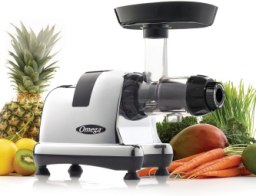
A. Some machines support additional foods, but the required strainers or attachments vary by model. The EanOruus 3-in-1 Cold Press Juicer is designed for juice, nut milks and fruit sorbet, while the Omega Juice Extractor and Nutrition System can also handle tasks such as nut butter and pasta. Check which accessories are included and follow the machine's instructions for each task.
Our expertise
Jennifer Blair has covered kitchen, home and lifestyle products for BestReviews since 2017. She has written over 100 articles on household appliances, such as toasters, vacuum sealers, air fryers, vacuum cleaners and more.
Jmar Gambol is a writer and product tester for BestReviews. He has written almost 200 articles and buying guides, as well as tested products as varied as coffee presses, robot vacuums, laptops and smartphones.
Molly Bremer is a Registered Dietitian and all-around food enthusiast. Molly has experience in clinical settings, the nonprofit world and outpatient settings. She also founded and directs her own private practice Mosaic Nutrition, which is a virtual practice serving clients in 23 states. Molly has been featured in Runner’s World, EatingWell and LIVESTRONG.