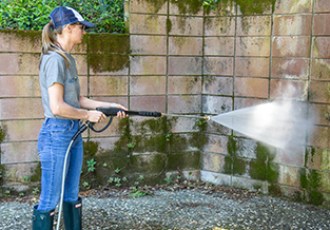
Buying guide for best pressure washers
Ready to buy now? Shop the best:
Whether you need to clean up stains on your walkway or eliminate caked-on grime from your car in record time, a pressure washer is an essential tool for many homeowners.
Gas-powered washers are usually best for tougher cleaning tasks such as stripping paint and removing stains, while electric washers are excellent for maintenance tasks like cleaning the driveway and washing cars. A pressure washer’s power is typically stated in pounds per square inch (psi), with higher numbers equaling more cleaning power. A higher psi also means higher water usage, measured in gallons per minute (GPM).
The BestReviews Testing Lab closely examined multiple gas and electric pressure washers, spending a week testing them in real-world conditions. We tested their cleaning power on different surfaces with various mess types, noting other important factors such as water efficiency, mobility and the quality of the included nozzles.
Our top option is the Greenworks 3000-PSI 2.0 GPM Cold Water Electric Pressure Washer, which is more than powerful enough to take on the toughest jobs. But if you don't need all that power, there are plenty of other excellent pressure washers to choose from below.
Editors' picks
Greenworks 3000-PSI 2.0 GPM Cold Water Electric Pressure Washer
Editors' Favorite
Type: Electric | Maximum Pressure: 3,000 psi | Dimensions: 18” W x 24" D x 38” H | Weight: 52 lb | GPM: 2.0
The Greenworks Pro is a powerful electric pressure washer that tackles tough cleaning jobs quickly and easily. It boasts one of the highest pressure-per-square-inch numbers for an electric washer (3,000 psi), meaning it can blast away dirt and grime effectively.
It features an extra-long, user-friendly hose and a large onboard soap tank. Additionally, it offers space-saving storage with the option to lay it flat or stand it upright.
While it's a bit on the noisy side, the Greenworks Pro 3,000 psi is a good option for those who prioritize cleaning power and speed in an electric pressure washer. Its maneuverability isn't the best, given its plastic wheels, but for stationary cleaning tasks, this Greenworks model won’t disappoint.
Greenworks 1500 PSI 1.2 GPM Pressure Washer
Great Value
Type: Electric | Maximum Pressure: 1,500 psi | Dimensions: 18.5" L x 10.28" W x 8.74" H | Weight: 12 lb | GPM: 1.2
The Greenworks 1500 PSI 1.2 GPM Pressure Washer is one of the best pressure washers for those who want an affordable way to clean vehicles, decks, fences and more. It weighs just 12 pounds, making it one of the easier units to carry and move around.
With a water flow of 1.2 GPM, this pressure washer is well-equipped to wash away dirt and grime. The 20-foot pressure hose and 35-foot power cord provide excellent flexibility, making it easy to move around quickly while in use. The soap applicator with the 25-degree spray angle lets you effortlessly clean any surface.
Its 1,500 PSI and compact design make this pressure washer suitable for various home DIY projects. Plus, it’s an electric unit, so you don’t have to worry about emissions or running out of fuel like with gas-powered washers.
Westinghouse WPX3400 Gas Pressure Washer
Best Budget Gas for Big Jobs
Type: Gas | Maximum Pressure: 3,400 psi | Dimensions: 19" L x 18.5" W x 21.7" H | Weight: 63 lb | GPM: 2.6
The Westinghouse WPX3400 Gas Pressure Washer is surprisingly affordable given its heavy-duty gas design. It offers a whopping 3,400 PSI and 2.6 GPM, making it one of the best options for tackling decks, sidewalks, siding, fences, railings and garage floors.
It's equipped with a 25-foot super-flex hose with a lightweight spray gun and five nozzles for versatility. It's compatible with pressure washer accessories, such as surface and undercarriage cleaners, and features a rugged steel frame with a 12-inch profile for improved stability and easy transport. Plus, never-flat wheels allow it to stand upright for better control and stability.
It’s a heavy-duty pressure washer that’s best suited for tougher jobs, such as washing away dirt and grime from brick, stone, concrete, wood, aluminum, and iron surfaces. It’s also well-equipped to tackle hard-to-reach areas, so it’s a fantastic choice for most DIY cleaning projects.
Sun Joe SPX3000 Electric High-Pressure Washer
Best Pressure Washer for Home Use
Type: Electric | Maximum Pressure: 2,030 psi | Dimensions: 19.5” L x 15” W x 22” H | Weight: 24.3 lb | GPM: 1.24
The Sun Joe SPX3000 Electric High-Pressure Washer offers midrange pressure and five nozzles, making it as versatile as possible to tackle all your home-based cleaning needs.
When we tested it, the nozzles contributed to a strong cleaning experience, and every nozzle had a clear use. For example, the 40-degree nozzle was great for gently washing cars, the 25-degree nozzle was our favorite for cleaning windows, the 15-degree nozzle was strong enough to blast gunk off a dirty grill and the 0-degree nozzle had the power to easily strip old paint.
Another excellent feature is its dual detergent bottles. They were among the best at mixing detergent with water for a delightfully sudsy experience. The bottles require some effort to take out and put back in, and notably, the detergent occasionally came through the spray wand even when the detergent was turned off. Still, having these bottles is an excellent benefit for general home cleaning.
We also found that the handle and wheels made it easy to move around, and the generous 35-foot power cord gives you plenty of freedom to reach a large area.
Craftsman Electric Pressure Washer
Best Light-Duty Pressure Washer
Type: Electric | Maximum Pressure: 1,700 psi | Dimensions: 18.33"L x 10.43"W x 11.25"H | Weight: 17.6 lb | GPM: 1.2
If you need a pressure washer that’s affordable and reliable enough for light-duty cleaning, the Craftsman Electric Pressure Washer is worth a look. It weighs just 17.6 pounds, has an integrated handle for easy carrying and delivers high PSI for effective cleaning of various surfaces.
With a 1,700 PSI and 1.2-GPM water flow, this pressure washer is built to handle everything from vehicles and driveways to siding and decks. Its 20-foot kink-resistant hose makes it easy to move around while washing, and the onboard storage compartment keeps the hose, cable and accessories together. Plus, it features an applicator for using soap with your pressure washer.
Although it’s not as powerful as other pressure washers, it offers more than enough to get most DIY jobs done in no time. Plus, its compact, lightweight design makes it one of the more portable units we’ve come across.
Giraffe Tools Wall-Mounted Pressure Washer
Best Wall-Mounted Pressure Washer
Type: Electric | Maximum Pressure: 2,900 psi | Dimensions: 22.05" L x 20.28" W x 14.96" H | Weight: 46.7 lb | GPM: 2.2
If you want a pressure washer that’s always readily accessible in your garage or backyard, the Giraffe Tools Wall-Mounted Pressure Washer is by far one of the best options. It’s a wall-mounted option, much like a wall-mounted hose, and it's always ready to go whenever you need to wash surfaces, such as vehicles or driveways.
It can generate up to 2,900 PSI with a maximum flow rate of 2.2 GPM, making it ideal for tackling stubborn dirt and grime. The retractable pressure reel is 100 feet long, allowing you to wash with more flexibility, and the soap tank lets you add detergent to clean vehicles with ease.
It doesn't require any assembly, and its accessibility is its defining feature. The hose is replaceable yet highly durable, as it can withstand both hot and cold temperatures. Overall, it’s the best choice for those who want to have a pressure washer ready to go at all times.
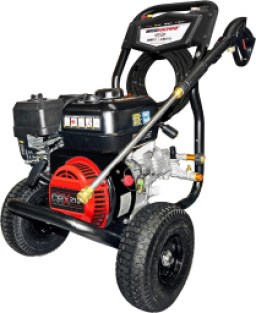
Simpson 3400 PSI Gas Pressure Washer
Best Pressure Washer for Businesses
Type: Gas | Maximum Pressure: 3,400 psi | Dimensions: 37” L x 30” W x 21” H | Weight: 61 lb | GPM: 2.5
The Simpson CM61083 Clean Machine has the raw power of 3,400 max psi combined with the versatility of three nozzles to blast away at anything a business would need to clean.
We were certainly able to get the most cleaning done with it, and it was the only washer we tested that was able to remove old smoke stains from a brick wall. It was also able to strip years of grime off a concrete floor.
Its parts all look and feel like they are high in quality, and it has excellent wheels and a good handle for hauling 61 pounds from worksite to worksite. The only downside of this pressure washer is its efficiency. After about 30 minutes of continuous cleaning at 2.5 GPM, our testing yard was flooded. But if you have big jobs to tackle, this pressure washer is for you.
DeWalt 3300 PSI Gas Pressure Washer
Best for Contractors
Type: Gas | Maximum Pressure: 3,300 psi | Dimensions: 41" L x 21" W x 24" H | Weight: 64 lb | GPM: 2.4
If you’re a contractor in need of a heavy-duty pressure washer for tough jobs, the DeWalt 3300 PSI Gas Pressure Washer is your best bet. This pressure washer offers outstanding water flow and maximum pressure for cleaning vehicles, decks and driveways.
Its 3,300 PSI of maximum pressure and a 2.4 flow rate make this pressure washer worth it for cleaning larger surface areas. It boasts a welded steel frame for superior durability and 10-inch pneumatic tires that make it easy to wheel around. The spray features a dial that lets you choose between five nozzle angles, and the 16-inch wand provides greater control.
At $400, it’s a pricey pressure washer, but for contractors who need more washing power, it’s truly a no-brainer. You won’t get this kind of pressure and flow rate from many other washers, and combined with its durable build, it's a must-have for heavy-duty washing.
EGO Power+ Electric Pressure Washer
Best Cordless Pressure Washer
Type: Battery | Maximum Pressure: 3,200 psi | Dimensions: 20.87" L x 14.96" W x 25.39" H | Weight: 36.2 lb | GPM: 2
The EGO Power+ Electric Pressure Washer is a practical option for homeowners who want cordless flexibility without sacrificing performance. Unlike other electric models, it runs on rechargeable batteries, so you don’t have to worry about working with long cords while washing.
It delivers maximum pressure of 3,200 PSI for removing dirt and grime, and features multiple power modes that allow users to adjust output for light or heavy cleaning tasks. It includes quick-connect parts for fast setup and a telescopic handle for easier transport and storage. The wand features a built-in display that shows the power mode and battery level during use, and you’ll get a full set of accessories, including a hose, spray wand, foam cannon and filter.
Designed for simple operation, this pressure washer provides up to 60 minutes of washing time on a full charge and offers the convenience of a battery-powered unit, which makes it more flexible than other electric units.
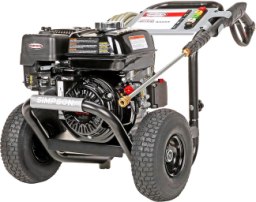
Simpson Cleaning PS3228 PowerShot 3300 PSI Gas Pressure Washer
Best Gas Pressure Washer
Type: Gas | Maximum Pressure: 3300 psi | Dimensions: 34” L x 21” W x 24” H | Weight: 74.8 lb | GPM: 2.5
An excellent heavy-duty model, the Simpson PowerShot Gas Pressure Washer is one of the best gas pressure washers around. Its solid build, impressive power and professional features allow it to tackle tough jobs wherever it's needed.
The Simpson PowerShot runs on a 3-quart, 3,200 RPM Honda GX200 gas engine and a triplex plunger pump with pump protection. It packs 3300 psi of cleaning force at 2.5 gallons per minute, strong enough to blast away graffiti or prep surfaces for repainting. It comes with five color-coded quick-connect nozzles, ranging from 0 to 40 degrees, a 25-foot Moreflex hose and a spray gun with extended lance.
The PowerShot weighs about 77 pounds, with a welded, powder-coated steel frame. It rolls on 10-inch pneumatic wheels for convenience. It's a professional rig ideal for contractors and small businesses who need a powerful pressure washer.
Other pressure washers we considered
Westinghouse ePX3100v Electric Pressure Washer
Customer Favorite
Type: Electric | Maximum Pressure: 2,100 psi | Dimensions: 9.6" L x 13" W x 11.8" H | Weight: 18 lb | GPM: 1.76
The Westinghouse ePX3100v Electric Pressure Washer is an affordable washer that’s terrific for hosing down your car, fence, driveway or patio. It’s a compact unit, but with 2,100 psi and 1.76 GPM, it provides enough power to tackle grime, grease, mildew, oil, tar, mud and rust.
It weighs just 18 pounds, and the built-in handle makes it easy to lift and move around. The 20-foot easy-coil nylon hose and pro-style steel spray wand provide improved control and extended reach. It features a detachable hose cannon that lets you mix in detergents for heavy-duty cleaning tasks. The pump automatically stops when it’s not engaged, helping save energy and preserve motor life.
Backed by a three-year limited warranty, this pressure washer is an excellent choice for anyone who wants to make cleaning decks, driveways, garage floors, stairs, patio furniture and vehicles more manageable.
Greenworks 2100-PSI Compact Electric Pressure Washer
Affordable Quality
Type: Electric | Maximum Pressure: 2,100 psi | Dimensions: 16.93"L x 13.11"W x 36.22"H | Weight: 1.5 lb | GPM: 1.2
The Greenworks 2100-psi Compact Electric Pressure Washer packs some serious power thanks to its 13-amp motor. It has a maximum pressure of 2,100 psi at 1.2 GPM, making DIY cleaning projects a breeze, whether it’s cleaning your deck, garage floor or vehicle.
The push-button start allows for effortless operation every time, and the included soap applicator lets you add detergent for heavy-duty cleaning on various surfaces. It includes multiple accessories for added flexibility during washing, such as a grip spray nozzle, a metal quick-connect wand with 25-degree, and 45-degree soap and turbo nozzles. The 25-foot kin-resistant hose and 35-foot power cord make it suitable for large cleaning jobs.
If you're looking for an affordable yet powerful electric pressure washer, the Greenworks 2100-psi Compact Electric Pressure Washer is a great choice. It’s portable, costs just $200 and doesn’t require any maintenance.
Greenworks 1800-PSI Electric Pressure Washer
Great Value
Type: Electric | Maximum Pressure: 1,800 psi | Dimensions: 10.63” L x 9.06” W x 12.8” H | Weight: 16.5 lb | GPM: 1.1
If you need a pressure washer for smaller jobs or just to have one handy around the house, take a look at the GreenWorks 1800 PSI Electric Pressure Washer. This handy unit is light, portable and easy to power, and it packs enough performance for most common pressure-washing tasks.
This GreenWorks pressure washer, as its model name states, offers 1800 psi of water pressure, strong enough to clean a car and driveway as well as fencing, siding and decks. At 1.1 gallons per minute, it provides enough flow to remove grime and dirt from most everyday surfaces. It comes with both a 40-degree wide-spray nozzle and a narrow turbo nozzle for more intensive jobs.
This GreenWorks electric pressure washer needs to be plugged into an AC outlet to work and swapping nozzles can be repetitive. But at just over 16 pounds, it's easy to pick up and carry, and it's priced to move. It also comes with a soap applicator.
Karcher K5 Premium Electric Pressure Washer
Best Pressure Washer for Cars
Type: Electric | Maximum Pressure: 2,000 psi | Dimensions: 34.33” L x 13.07” W x 16.77” H | Weight: 32 lb | GPM: 1.4
The Karcher K5 has great pressure at a max of 2,000 psi, so it can hose down your car much better and quicker than a plain garden hose. Plus, its low gpm of 1.4 means you won’t waste too much water while you clean.
Plenty of quality extra features are included. The best of these is a 25-foot kink-resistant hose that sits on a reel for easy winding when the job is done. Other high-end features include an adjustable onboard detergent tank, a variable-angle spray wand, a direct-jet spray wand and a 25-foot power cord.
How we tested
The BestReviews Testing Lab ran each pressure washer through the same tests, using the same processes to eliminate as many variables as possible. We evaluated them in the following 11 areas.
Assembly and setup
We examined how easy or difficult it was to assemble each pressure washer. Most of the electric pressure washers were essentially plug-and-play; we needed only to connect the hoses and a handful of parts, such as the spraying wand. The gas-powered washers were more complex. For example, the Simpson required the addition of engine oil and connecting hoses. Both types occasionally had little pieces (handles, hooks) that needed to be screwed in.
Cleanup
The inverse of setup, we checked the cleanup process for each item to see how easily it broke down for storage. Most are designed to stay built for storage, with hooks and such to hang hoses. The only step that was always required was emptying the hose of water to avoid damage. This usually meant triggering the washer without a water connection to force out any lingering water.
Construction
We inspected the pressure washer build and material quality to assess durability and reliability. We had no issues with the body of each pressure washer, but some of the electric washers, namely the PowRyte, used cheap plastic for their extra pieces.
Detergent tank
For the washers with detergent tanks, we filled them as directed and evaluated the degree to which soap impacted cleaning power. We noted how much extra work was required to clean and rinse each unit after use. We found that the washers with detergent bottles that connect to the spray wand performed poorly, with low detergent-mixing capabilities. Those with actual tanks performed much better since they pulled the detergent into the line with the water.
Efficiency
This test compared water usage and flow rate (in gallons per minute) against the cleaning tasks we performed. Electric washers with lower GPM had the best efficiency, cleaning our targets without leaving too much water around. The gas-powered washers had the worst efficiency since they used high water amounts to deliver extra power during the same testing window, which was about 30 minutes of continuous cleaning.
We suggest using a gas-powered washer for older, tougher messes and an electric washer for maintaining cleanliness.
Leakage
Couplings and hoses were thoroughly inspected during operation to check for leaks and loose connections. We found no rhyme or reason behind any given machine’s potential leaks. Some dripped here or there at the hose connections; some didn’t. None had issues with hose leaks.
Noise level
We took a decibel meter to each pressure washer to see how dangerous they are to your hearing over extended periods. We found that most generated 85 to 95 decibels, which is about as loud as a gas-powered lawnmower or motorcycle, according to the Centers for Disease Control and Prevention, so wear hearing protection when using one.
No-kink hose
We checked hose length and examined how easy or difficult it was to kink with regular use. All the hoses were no-kink and most were 20 feet long. Nearly all were packed tightly enough that they wanted to stay in the spiral they came in. We suggest stretching your hose out rigorously before using it.
Nozzles
We checked the quick-connect nozzles included with the pressure washer for smooth, easy installation and water tightness. Not one pressure washer had nozzle issues.
Power
We tested each pressure washer’s cleaning power on a variety of surfaces and materials, using the included nozzles to assess their effectiveness. The surfaces we cleaned were:
- Cast iron chairs
- A stained brick exterior
- A rusted smoker
- A wooden fence
- A concrete patio
- Windows
- Cars
Weight and mobility
We noted each pressure washer’s weight during cleaning and its general mobility and portability while moving the machine between cleaning targets. Every washer had some kind of mobility aid, whether it was the Ryobi’s handle or the wheels on several electric and all-gas washers. The electric washers were light enough to lift somewhat easily, while the gas washers were too heavy to lift comfortably.
What to consider before buying a pressure washer
Cleaning power
The cleaning power of any given pressure washer is a combination of its maximum water pressure (measured psi), flow rate (measured in GPM) and what nozzle is used on the spray arm to direct the water. The higher the pressure and greater the rate, the more potential cleaning power a pressure washer has.
When shopping, keep in mind the type of cleaning you want to do, and don’t buy more potential power than you need. Buying more only means you’ll use more water, which is a waste of both water and money.
For average cleaning needs, we found that 1,500 psi and 1.2 GPM were usually enough. Double that if you need to clean an old, tough mess such as a deep stain.
Water pressure
The water pressure of a pressure washer is measured in psi. An important quirk to note when shopping for pressure washers is that the listed psi is always the maximum psi it can reach. Using a nozzle with a wider pattern lowers the psi, making it safer to clean more delicate surfaces. Additionally, the maximum psi is usually measured at the initial pull of the trigger because psi always drops some after pulling the trigger.
Your primary concern when shopping should be psi, though more isn’t always better. In our tests, we found that 1,500 to 2,000 psi was typically enough for basic cleaning, and 3,000-plus was necessary for handling tough messes.
Flow rate
The flow rate of a pressure washer correlates to how much water is used during operation. In this case, we are talking about gallons per minute. To reach a higher psi, more GPM must also be used. We suggest focusing on psi when shopping for a pressure washer.
Consider GPM as a tiebreaker if you’re stuck between models with identical psi, and go with the lower GPM since that usually means you’ll use less water in the long run.
Nozzle types
Electric pressure washers have adjustable or replaceable nozzles. A selection of settings allows you to change the spray angle to suit your task. The lower the angle, the more concentrated the stream of water. Thus, the more effective the cleaning.
Adjustable nozzles are easier to use: Simply twist until you reach the appropriate setting. Replaceable nozzles must be taken on and off, and there is always the chance that they could be lost. That said, they may give you more options than a standard adjustable nozzle.
No significant difference in performance exists between the two nozzle types. If you end up needing more nozzles than your machine has, you can find universal washer attachments. Make sure any attachments you use are rated for the same psi as your pressure washer.
Hose
Consider the length of the pressure washer hose, and make sure it’s long enough for your projects. It should be rugged and durable, but you also want something flexible that doesn’t retain too much coil memory. An excess of coil memory can make it difficult to extend the hose to its full length, and it may also snag things more easily.
Think about the material and quality of the hose, too. Most lower-cost hoses use PVC plastic, which is durable but tough to manipulate. Others use rubber, which is easier to move but heavier. Polyurethane is the best of both worlds, but it can be expensive.
A good hose is easy to roll and unroll. Most have a space to wrap the cord when the machine isn’t in use. Some have a handle that lets you quickly reel in the cord so you don’t have to wrap it up manually.
Soap dispensing
Some electric pressure washers have a built-in soap tank. You fill it with soap before you begin, and the pressure washer automatically mixes it with water as it shoots out of the nozzle. This is the easiest approach if you’re going to be moving around, but you have to clean them when you’re done to avoid damage when the soap dries.
Other models have a siphon tube that you place in a soap container. The soap is sucked up and mixed with water before coming out of the nozzle. These can be difficult when moving around if the container doesn’t attach to the pressure washer. Otherwise, the pros and cons are similar to those of built-in tanks.
The final type of soap container is a little bottle that attaches to the spray wand. This is most commonly found on cheaper pressure washers, and it is the only system we disliked. We found the soap and water mixing was consistently too poor to be worthwhile.
Mobility
Consider the size and weight of a pressure washer before buying. Medium-duty pressure washers tend to weigh between 15 and 25 pounds. These usually have a handle on the top, some wheels or a combination of the two to help you move them around. Larger hand-truck options can tip the scales at nearly 50 pounds. These almost always have handles and wheels since they’d be nearly impossible to use otherwise.
Generally speaking, heavier washers have higher pressures and flow rates, and lighter washers have lower numbers. During testing, we found that light-to-medium washers were easy enough to haul around by a handle, though wheels helped when we had them. Heavy washers are only really a burden if you have to lift them.
Cost
You could pay anywhere from $100 to $400 for an electric pressure washer. The range in price largely reflects differences in performance and durability. If you’re looking for a compact unit to handle light-duty tasks, we recommend spending at least $135 to $150. Spend $200 or more if you want something with added power or advanced features, such as a detachable soap tank or extra nozzle choices.
Gas pressure washers can cost much more. Entry-level washers for average at-home use usually cost $200 to $400. These are usually as powerful, if not more so, than high-end electric washers. If you’re a house flipper or your home has some extra-tough messes, you can spend up to $1,000 on a gas washer with the ability to tackle big issues. Finally, if you’re looking for a washer for professional-level cleaning, you can expect to spend at least $1,000 and as much as $10,000-plus.
Tips for using a pressure washer
- Read the manufacturer’s instructions before use, and follow them precisely. Improper use could result in damage to the item you’re cleaning, or worse yet, a serious physical injury.
- Start with the gentlest nozzle setting. You can move up from there if you need more power. You don’t want to start too strong, as you could damage the area you’re trying to clean.
- Wear goggles, earplugs and sturdy shoes when operating the pressure washer to protect yourself against injury.
- Hold the pressure washer nozzle at least 6 inches from the item you are cleaning. Move closer if you need more pressure to get a better clean.
- Never leave your pressure washer spray gun unattended while the machine is turned on.
FAQ
Q. What cleaning solutions can I use in my pressure washer?
A. You should only use detergents that are designed for pressure washers. Other cleaners (like bleach) could damage your pressure washer pump and shorten the life of the machine.
If you have questions about what types of cleaners can be used in your pressure washer, consult your owner’s manual.
Q. Can I use hot water in my pressure washer?
A. There are pressure washers specifically designed for hot water, but the standard pressure washer is meant to be used with cold water. Using hot water in one of these machines could damage the pump.
Q. How do I clean out a clogged nozzle?
A. Turn off the machine, and disconnect the spray gun before examining the nozzle. If it is clogged, use a thin piece of wire to poke out any obstructions. Then, run water through it to remove any remaining debris. Connect it to the pressure washer, and try again.