Buying guide for best Epson printers
Ready to buy now? Shop the best:
Do you know what the name “Epson” means? In 1968, the company that eventually became Epson introduced its first electronic printer, the EP-101. The succeeding generation of printers after that one were called Epson, for “EP’s son.”
Cute origin stories aside, Epson is one of the world’s top brands in printing and imaging, and a pioneer even now. Founded in Japan during World War II, the company’s portfolio is vast, ranging from receipt printers to semiconductors. But our focus, and its biggest claim to fame, is its printers.
Epson printers offer forward-thinking technologies that aim to push the envelope of how a printer works, while saving customers money and reducing environmental impact. Its all-inkjet lineup as of 2026 flies in the face of longstanding presumptions about what inkjet printers are good for, and its tank-based ink technology aims to eliminate cartridges once and for all.
Epson makes dozens of printer models for the home or office, not to mention specialty models in all kinds of other applications. Our top pick, the Epson EcoTank ET-4950, exemplifies the company’s product direction, with its fast output, high quality and low running costs.
Editors’ picks
Epson Eco Tank ET-4950
Editors’ Favorite
Print Quality: Up to 4800 x 1200 dpi | Print Speed: Up to 18 pages per minute | Paper Capacity: 250 sheets | Connectivity Options: Ethernet, USB, Wi-Fi
The flagship model in Epson’s mainstream printer line, the Epson EcoTank ET-4950 is an all-around performer. It’s the ideal Epson model for a work-from-home business or home office, with printing, copying, scanning and faxing all in one.
The EcoTank ET-4950 has a maximum print speed of 18 pages per minute in black and white, or 9 ppm in color. It has an internal paper tray that can hold up to 250 sheets of letter-sized paper, with automatic duplexing standard. It prints at a maximum 4800 (horizontal) by 1200 (vertical) dpi, using Epson’s PrecisionCore laser-quality print head.
The ET-4950’s ink tanks last up to 6,600 pages before refilling, according to Epson, with a black ink refill lasting another 7,500 pages, for outstandingly low costs per page. It supports scanning and copying, including the use of a 30-sheet auto-document feeder. It also has a fax function. It connects via Wi-Fi, USB, Ethernet, AirPrint and Mopria.
Epson Eco Tank ET-2803
Great Value
Print Quality: Up to 5760 x 1440 dpi | Print Speed: Up to 10 pages per minute | Paper Capacity: 100 sheets | Connectivity Options: USB, Wi-Fi
Even if you’re not a WFA warrior and you just need an occasional print job, you can still benefit from Epson’s EcoTank series. The Epson EcoTank ET-2803 is multifeatured and affordably priced, but offers the same kind of economical running costs of other all-in-one printers in the line.
The EcoTank ET-2803 prints at a high 5760 (horizontal) by 1440 (vertical) dpi resolution, promising true photo quality on the right paper. It has a top black-and-white print speed of 10 ppm, 5 ppm color, with a 100-sheet paper tray and the ability to print even on banners up to 47 inches long. It doesn’t, however, support automatic duplex printing. It comes with two years of ink, with a single black replacement bottle lasting some 4,500 pages.
The ET-2803 has a full-color flatbed scanner with color-copying capability, although there’s no document feeder or fax feature. It connects over Wi-Fi and USB, and also supports AirPrint, Mopria and Android Printing.
Epson Workforce Pro WF-4830 Wireless All-in-One
Big & Fast
Print Quality: Up to 4800 x 2400 dpi | Print Speed: Up to 25 pages per minute | Paper Capacity: 500 sheets | Connectivity Options: Ethernet, USB, Wi-Fi, Bluetooth
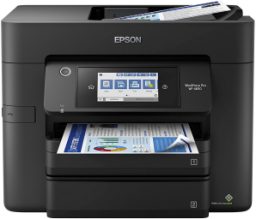
As an office-oriented model, the Epson Workforce Pro WF-4830 is a great choice for a small business. If your team or organization prints a lot of documents, this is the Epson for you.
The WorkForce Pro WF-4830 can print as fast as 25 pages per minute in black and white, or 12 ppm in color. It has two 250-sheet paper trays you can refill as needed, and a 50-sheet auto document feeder for its scanner and copier. It prints at 4800 by 2400 dpi, horizontal by vertical, with Epson’s PrecisionCore print head, and it has a maximum monthly duty cycle of 33,000 pages.
Unlike other Epson printers, the WF-4830 supports Bluetooth LE connections, but it’s more likely you’ll choose its robust 10/100 Mbps Ethernet port or its Wi-Fi networking. It also copies, scans and faxes, with built-in screen lock for its roomy touch-screen control. At 16.7 inches deep and nearly 20 inches wide, it has a big footprint, but that’s to be expected for a workgroup-level printer.
Epson ET-8550 Wide-Format Color All-in-One Supertank Printer
Best for Photo Prints
Print Quality: Up to 5760 x 1440 dpi | Print Speed: Up to 16 pages per minute | Paper Capacity: 100 sheets | Connectivity Options: Ethernet, USB, Wi-Fi
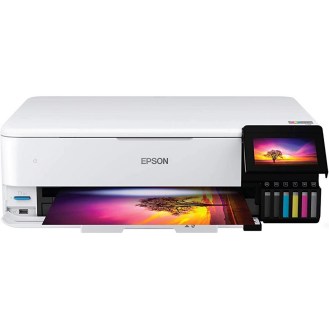
If printing photographs and art is your main ambition, look no further than the Epson EcoTank Photo ET-8550. It handles media up to 13 by 19 inches in size and uses Epson’s Claria six-color high-performance inks.
As a photo printer, the ET-8550 is optimized for high-quality output, with a top resolution of 5760 by 1440 dpi. Its six-color process allows for deeper, richer output than a standard CMYK printer, and it supports paper stock up to 13 by 19 inches in size and up to 1.3 millimeters thick. It still has a robust top speed of 16 ppm black and white, and Epson boasts it can print out a 4-by-6-inch photo in less than 15 seconds with its PrecisionCore print head.
The ET-8550 has a 100-sheet semi-enclosed paper tray. It has a 4,800 dpi 48-bit flatbed scanner with color-copy capability, but there’s no document feeder for automated scanning. It comes with enough ink for 6,200 pages before refilling. It connects over Wi-Fi, Ethernet, USB or AirPrint and similar services.
Epson EcoTank Pro ET-5850
Best for Heavy Print Jobs
Print Quality: Up to 4800 x 2400 dpi | Print Speed: Up to 25 pages per minute | Paper Capacity: 500 sheets | Connectivity Options: Ethernet, USB, Wi-Fi
The Epson EcoTank Pro ET-5850 straddles the border between a personal and workgroup printer. It’s as robust as an EcoTank printer can get without crossing over into the business-oriented WorkForce line.
The EcoTank Pro ET-5850 prints at a businesslike speed of up to 25 ppm, and it can reach that speed in both black-and-white or color. It has two 250-sheet internal paper trays, and also supports a five-sheet rear paper feed. It supports both auto-duplexing and automated two-sided scanning and copying. Its DuraBrite inks are intended for high-quality output. It comes with enough ink for 7,500 black-and-white or 6,000 color pages.
With a maximum print resolution of 4800 by 2400 dpi, the ET-5850 can accurately print photos, graphics and charts. It supports faxing as well, and connects over Ethernet, USB, Wi-Fi, AirPrint and more.
How we analyzed
To create this buying guide, we dove into Epson’s product line and product history, updating ourselves on the company’s most recent innovations and priorities. We read up on Epson’s ink tank and print-head technology, its environmental priorities and its market presence. We evaluated each model for basics such as print speed, print quality, features and price per page, as well as any extras they offered. We chose models based on overall performance, value and special features when applicable.
Choosing an Epson printer
Product lines
Epson has a multitude of product lines ranging from home printers to industrial models. If you’re in the market for a printer, you’re likely looking for an all-around model for your home or office, or a specialized photo printer.
EcoTank and EcoTank Pro
Epson’s main consumer label is the EcoTank line, officially launched in 2015. Epson EcoTank printers run the gamut from home to office models, with both print-only and all-in-one models. They’re named for their use of refillable ink tanks rather than disposable ink cartridges, providing lower running costs and environmental impact over time.
WorkForce and WorkForce Pro
WorkForce is Epson’s business-oriented line designed for office use. Epson WorkForce printers use the same printing technologies as other Epson printers, but are optimized for higher capacity, higher output, robust durability and wired networking.
Expression
The Expression line is Epson’s entry-level, budget series of mostly cartridge-based inkjets. These light-duty printers and all-in-ones are good for homework assignments, pictures to put on the fridge or quick color copies. If you need to print lengthier documents or at higher quality, such as for college or WFH, you may want to move up to an EcoTank or WorkForce model.
Photo printing
Epson has a lot of printers that excel at, or are dedicated to, printing photos and other images. Their EcoTank Photo printers are inkjet-based, but use a six-color process instead of the CMYK four-color set found in all-purpose inkjets. These photo printers can print on a wide variety of paper types and sizes and often have superior line detail to the dye sublimation printers used by photo printing services. Commercial dye-sub photo printers, which Epson also makes, produce the smooth, glossy prints we associate with “real” printed photographs.
Specialty, commercial and industrial printers
Epson’s product catalog extends beyond consumer printers. Epson makes commercial and industrial printers, from label makers to point-of-sale receipt printers to large-format signage printers. It also makes architectural printers, media printers and textile printers. It even still makes dot matrix printers that use continuous-feed paper, found, among other places, behind airport gate counters.
What about laser printers?
Epson announced in 2022 that it was discontinuing the production of consumer laser printers, citing both manufacturing costs and environmental concerns. Instead, it has promoted its PrecisionCore ink technology as comparable to laser printers in speed and quality, and superior in terms of energy use and running costs. As of 2026, Epson no longer makes or sells laser printers.
Costs and consumables
The costs of having a printer don’t stop at purchase. Printers have consumables, like ink and paper, that need regular refilling or replacement. Printers also use power and have a lot of moving parts that can break down or wear down over time.
- Price per page: how much it costs to print a single page. If you divide the cost of ink by the number of pages that ink can print, you get the price per page. 2 cents per page or less is ideal.
- Pages per month: measures the maximum number of pages a printer can print per month. Also known as a duty cycle. 5,000 pages per month is a good minimum target. Occasional home use is lower, workplace use is higher. (Most people never get close to this number in regular use.)
- Lifespan: how long a printer is expected to last. This depends a lot on how hard the printer works, as parts can wear out with heavy loads. A minimum of three years is the least you should expect, but some printers can last 10 years or longer with light use.
Epson printer features
Printing technology
As of 2026, all new consumer and mainstream Epson printers are based on inkjet technology, where tiny dots of liquid ink are applied to paper.
- EcoTank: Inkjet printers that use refillable ink tanks rather than disposable cartridges. A full tank can last a year or more before refilling. Offers some of the lowest prices per page of any printer.
- PrecisionCore: Epson’s proprietary printing technology aimed at replacing laser printer tech. Uses a printer-on-a-chip system for heat-free, ultra-high-resolution output.
- MicroPiezo: The precursor to PrecisionCore. Uses piezoelectricity to transfer ink onto paper. Found on lower-end Epson models.
- Cartridge: Traditional ink cartridges. Depending on how much you print, it can have much higher running costs and produce more e-waste than tank printing.
Resolution
Measures the sharpness and quality of prints in dots per inch or dpi. Printer resolution is expressed in horizontal by vertical values, such as 1200 by 600 dpi. Most Epson printers in 2026 have 4800 by 1200 dpi. By comparison, printers in the 1990s and 2000s boasted about 300 or 600 dpi. Higher-end printers and photo printers tend to have higher vertical dpi.
Print speed
How fast a printer can print. Usually measured in pages per minute or ppm, often expressed in terms of color printing speed and black/white printing speed. Color pages typically take longer than black and white, so the black/white speed is often given as a standalone value. 15 to 20 ppm is a good minimum value for regular home use; you can go lower if you print only occasionally.
Paper capacity and handling
The more sheets of paper a printer can hold, the better, if only to avoid the annoyance of running out of paper during a job. Home users can get away with a 100-page capacity, but 250 is better.
- Paper size: Most consumer Epson printers support papers of various sizes smaller than US Letter (8.5 inches by 11 inches) and US Legal (8.5 inches by 13 inches), or international A4 (210 mm by 297 mm). These smaller papers include photo paper sizes, such as 4 inches by 6 inches or US business envelopes.
- Epson photo printers can support larger formats like A3 (297 mm by 420 mm) up to 13 inches by 19 inches. They can also print on heavier stock, such as specialty papers, photo papers or light cardstock
- Duplexing, or the ability to print on both sides of a page automatically, is common throughout Epson’s EcoTank and WorkForce series, but not universal.
Scanning, copying and faxing
Printers that have scanning, copying and faxing capabilities are referred to as all-in-ones or AIOs. Having at least a flatbed scanner with copying functionality is a common feature for many Epson models, although the company still makes print-only models as well.
- An AIO printer with a flatbed scanner makes a convenient color copier
- Flatbed scanning is helpful when you need a better scan of a document than your smartphone can provide.
- An automated feeder even makes multipage scanning and copying possible.
- Faxing is still a sought-after feature in business and professional work, including healthcare and legal firms. Printers provide far superior print and paper quality to vintage faxes of the past.
Connectivity
Epson printers come with both wired and wireless interfaces. Most consumer and office models have a USB connection, usually a high-speed USB-B port. Most also support Wi-Fi to connect to a home or office network. Many home and office models support other wireless printing protocols, such as Mopria or Apple’s AirPrint. Office and corporate models also have Ethernet ports for wired networking.
- During the 2010s, Epson joined competitors in offering NFC-based wireless connections. This feature has been generally phased out.
- Few Epson printers support Bluetooth.
Tips
- Print regularly. Inkjets, even tank models, can clog up if left unused for long periods of time. Regular printing keeps things running smoothly.
- Keep your printer on. Like computers and smartphones, Epson printers do maintenance and firmware updates while powered but idle.
- Keep up to date. Make sure your Epson printer is running the latest firmware, and that your computer or other device has the latest drivers, especially if you use specialized features.
- Consider a printer cable. Wi-Fi is pretty much the default way to connect to an Epson printer, but you never know if you might need the dependability of a USB cable. Get one that fits your usage: USB-B to USB-A, or USB-B to USB-C.
- Use genuine ink. Dupe or remanufactured cartridges may cause errors or jams, and third-party ink bottles may not have the right properties for your Epson printer.
FAQ
Q. How much does an Epson printer cost?
A. Epson printers for home or home office use cost between $59 for an entry-level Expression all-in-one, to over $1,000 for WorkForce Pro printers that can handle heavy office usage. Its main EcoTank line for home and home office runs from $159 for a single-function model to $699 for its large-format model. Remember that the cost of replacing ink cartridges makes those low-end models less economical compared to tank-based printers.
Q. Will an Epson printer work with my Mac?
A. Yes. Modern Apple Macintosh computers come with built-in drivers for most current Epson printers, so most basic functionality will be “plug and play.” To unlock advanced functionality, install the included software and drivers from Epson.
Q. Can I use an all-in-one’s fax machine if I don’t have a landline in my home?
A. No. When an all-in-one lists fax functionality, it means that the printer has a port for a phone cable to connect to your existing landline to send faxes. If you don’t have a landline, that’s OK. There are plenty of paid online fax services that can use the internet to send documents to others’ fax machines.
Our expertise
Jmar Gambol is a writer for BestReviews. He has written dozens of articles on a variety of subjects, including tech, audio, robots, food and travel. He is due to replace his current printer any day now.