Buying guide for Best rock tumblers
Ready to buy now? Shop the best:
A rock tumbler can expose the inner beauty of stones you find on your travels, at the beach or in your backyard, polishing their rough exterior to reveal layers and colors. This isn’t a difficult hobby, but it requires patience, a handful of supplies and accessories, and a bit of trial and error.
The two primary types of rock tumblers, rotary and vibratory, operate at different speeds and produce slightly different results. If you’re just starting out, consider a smaller, less expensive model to learn the tumbling process and find out what types of rocks give you the results you want. The more common rotary tumblers are best suited for polishing irregularly shaped rocks that have angles or points, though this process takes about a month. Vibratory tumblers shake rocks to polish them in as little as a week, but the rocks must be fairly round to begin with for best results.
The size of the tumbler determines how many rocks you can polish at once, and some high-end models have two tumblers for polishing twice as fast or tumbling rocks with different grit levels. If you have a small living space, you should also consider the noise level because some tumblers are quite loud.
We researched and tested rock tumbler kits and found the National Geographic Professional Rock Tumbler Kit to be the best for most people. Our experts recommend a single-drum model to begin with, though a double-drum tumbler is a worthwhile investment if you’re an avid rock collector.
Editors' picks
National Geographic Professional Rock Tumbler Kit
Editors' Favorite
Skill: Beginner/advanced | Capacity: 2 lb | Settings: 3 | Timer: Yes | Includes grit: Yes
Making rock tumbling easy and educational, the National Geographic Professional Rock Tumbler Kit comes with everything you need to get started. Suitable for children aged 8 and up, it's able to polish 2 pounds of rocks at a time.
The rubber barrel is durable and has a tight-fitting seal that does a good job of preventing leaks. The barrel is also 75% quieter than plastic models. And the results are gorgeous. The unique GemFoam media creates a shiny finish and can be reused if you wash the grit off the cubes.
On the slowest setting, this tumbler can produce high-quality polished stones in a little over the usual four weeks. The two included belts are fairly durable, and customers say they can last over a year.
KomeStone K1 Rock Tumbler Kit
Great Value
Skill: Beginner | Capacity: 2.5 lb | Settings: 3 | Timer: Yes | Includes grit: Yes
The KomeStone K1 Rock Tumbler Kit is one of the best value picks for experienced users who want something affordable yet reliable. It’s also intuitive enough for first-time users to learn quickly.
With a 2.5-pound capacity, this tumbler is an upgrade over entry-level 1-pound models and lets you polish more stones per batch. It features a rubber barrel so it’s significantly quieter than models with plastic barrels, and you can choose from three speed settings and program each polishing stage right on the LCD screen with the adjustable nine-day digital timer.
It’s one of the best all-around choices for anyone looking to start rock tumbling. You’ll get 1 pound of rough rocks, all four polishing grits and a full-color guide to get started with confidence.
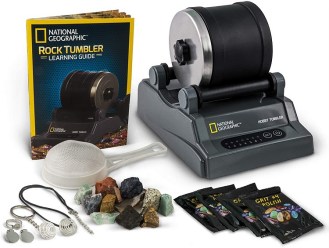
National Geographic Hobby Rock Tumbler Kit
Best for Hobbyists
Skill: Beginner | Capacity: 1 lb | Settings: One | Timer: Yes | Includes grit: Yes
Our 8-year-old tester loved using the National Geographic Hobby Rock Tumbler Kit with a bit of help from a parent. This beginner tumbler was easy to set up and produced great results after about a month (the longer the rocks tumble, the better the results — so patience is required ).
It includes a few basic tools like jewelry fasteners and strainer, and the guide takes you through the steps to get your rocks as shiny as you want them. The variety of included stones make for a good first batch, and the operation is simple enough to start tumbling on day one.
The seven-day timer is perfect for checking the stones at the end of each of the four stages. Its 1-pound capacity is large enough for casual rock collectors or jewelry makers. It has a few speed settings and is quieter than similar rotary tumblers.
We liked that the rubber drum not only muffles the noise but also makes the drum more durable than plastic models. However, our tester's mom says, "It's too noisy to keep indoors because it needs to be tumbling the rocks 24-7; you would definitely want to put it in a garage or somewhere outside." Despite that, this product was a hit. "It’s a great educational product for kids 8 and up to physically show them how a smooth gemstone is created," our tester's mom says. "You can also use it to make sea glass."
National Geographic Starter Rock Tumbler Kit
Best for Kids
Skill: Beginner | Capacity: 1 lb | Settings: None | Timer: No | Includes grit: Yes
Rock tumblers are a favorite for kids who collect rocks. This National Geographic Starter Rock Tumbler Kit is an ideal gift for a youngster interested in STEM but also works for anyone who wants a way to easily polish pebbles and semiprecious stones. It's got a simple, straightforward design with no controls, just a bright yellow drum lined in tire rubber to minimize noise. Plug it in to power it on and unplug the cord to stop.
The National Geographic Starter Rock Tumbler has a capacity of 1 pound and comes with a half pound of sample rough gemstones. It also includes a sieve and four bags of grit to get your gems smooth.
Jewelry settings are also included to help you make the most of your polished pieces. Like other National Geographic-branded merchandise, proceeds help benefit the National Geographic Society's mission of research and exploration.
KomeStone K4 Quiet Rock Tumbler Kit
Affordable Tumbler with Digital Controls
Skill: Beginner, Experienced | Capacity: 7 lb | Settings: 4 | Timer: Yes | Includes grit: Yes
Whether you’re a beginner who’s never polished a single rock or a long-time rock-tumbling expert, you’ll find plenty to love about the KomeStone K4 Quiet Rock Tumbler Kit.
The tumbler features a double-barrel design, each with a 3.5-pound capacity, meaning you can polish well over two or three times more than entry-level tumblers. The four-speed settings toggle gives you one more speed compared to other models, so you have more precise control across stone types and stages. It also has a nine-day timer, and you can pause at any time to check the progress.
You can run two batches of different rocks at once, and the kit comes with everything you need to get started, including 2 pounds of rocks and eight bags of grit. It’s a solid overall pick that isn’t too expensive, making it perfect for beginners or experienced tumblers.
AtoRock A1 Professional Rock Tumbler Kit
Best Large Single-Barrel Tumbler
Skill: Beginner, experienced | Capacity: 4 lb | Settings: 3 | Timer: Yes | Includes grit: Yes
The pro-grade AtoRock A1 Professional Rock Tumbler Kit is a solid option for both beginners and intermediate users. Whether you’re a hobbyist or a serious collector, this tumbler delivers high-level results that are noticeably better than most entry-level models.
Equipped with a 4-pound rubber barrel, this tumbler quietly polishes all kinds of rocks in large batches. The nine-day timer lets you run each stage automatically without you even having to be near the tumbler. Just program it once per stage, and you’re good to go. The kit includes everything you need: 1 pound of premium rough gemstones, four polishing grits, jewelry findings and a mesh strainer.
It’s a quiet, easy-to-use tumbler that delivers polishing comparable to even some high-end models. It’s also sturdy and well-built, making it an excellent budget-friendly tumbler for most users.
Dan&Darci Advanced Professional Rock Tumbler
Feature-Packed
Skill: Advanced | Capacity: 1 lb | Settings: 3 | Timer: Yes | Includes grit: Yes
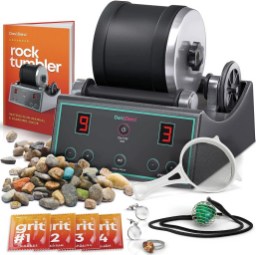
Our top pick, the Dan&Darci Advanced Professional Rock Tumbler, works well not only as a first tumbler but also as one you can continue to use if you find that you really enjoy the hobby. The included guide makes it easy to get started, and the four grit packets are enough for your first batch.
The replacement belt drive ensures that you can use your tumbler for several batches, and you can purchase additional grit from the company’s website. You can adjust the speed to account for the type of rocks you’re using and how much polishing they need. It produces round, shiny stones after about a month of continuous use.
The price of this tumbler puts it in the middle of the range, and it’s an excellent value when you consider the included accessories: rocks, four levels of grit, strainer and jewelry fasteners.
Koolstone C1 Rock Tumbler Kit
Most Comprehensive
Skill: Professional | Capacity: 2.5 lb | Settings: 3 | Timer: Yes | Includes grit: Yes
The Koolstone C1 Rock Tumbler Kit is a nice-sized tumbler that stands out for its all-rubber drum, which makes it one of the quieter models available — a major plus if you’re concerned about noise, especially if you have a small home. It includes basic accessories, a pound of rough stones and ceramic media, the last of which many other kits leave out.
The 2.5-pound barrel allows you to polish multiple rocks in a single batch. The tumbler also has a nine-day timer that automatically turns off the machine when it finishes. Its memory function saves your progress if the tumbling process is interrupted, though, so you don’t have to start over. Best of all, the clear, user-friendly display and control panel make operation straightforward even for beginners.
Leaks are unlikely with the lid’s rubber seal, so you don’t need to worry about setting the tumbler on various surfaces. If you follow the instructions carefully, it consistently produces shiny polished stones after a few weeks.
National Geographic Platinum Series Ultra Quiet Rock Polisher Kit
Easy to Use; Outstanding Results
Skill: Beginner, Intermediate | Capacity: 2 lb | Settings: 3 | Timer: Yes | Includes grit: Yes
The National Geographic Platinum Series Quiet Rock Polisher Kit delivers outstanding polishing and is surprisingly quiet given its robust build.It features a 2-pound capacity, which is great for beginners or intermediate users who prefer small batches.
Three speed settings let you fine-tune polishing, and the timer lets you automatically program each stage so you don’t have to monitor the tumbler. Plus, one standout feature is the reusable GemFoam rock polisher, which gives stones an ultra-refined look and feel.
This is a fantastic option for beginners and experienced users who want something robust but still compact for polishing all kinds of rocks. It’s quiet, includes four bags of grit, and customers rave about how shiny it leaves rocks.
Thumler's Tumbler Model B Heavy-Duty 15# Rock Tumbler
Best Heavy-Duty Tumbler for Collectors
Skill: Experienced | Capacity: 15 lb | Settings: 1 | Timer: No | Includes grit: No
If you’re an experienced collector who wants a high-duty tumbler, look no further than the Model B Heavy-Duty 15# Rock Tumbler. This pro-grade rotating tumbler delivers outstanding results that you just won’t get with cheaper entry-level models.
With a hexagonal shape, this tumbler works more efficiently than round models, and its huge 15-pound capacity lets you polish large batches in one go. The fan-cooled motor is built for continuous use without overheating, and the rubber liner is replaceable once it wears out.
The only real downside to this tumbler is that it’s not a full kit, so it doesn’t come with any grit or starter gemstones. But if you’re a serious collector who wants the best-looking stones to put on display, this tumbler lets you work faster and delivers remarkable results.
How we tested
After researching dozens of tumblers, we compared the functionality and results of the eight tumblers above and gave the National Geographic Hobby Rock Tumbler Kit a spin. We recommend this model for its easy setup and reliable results, even with your first batch.
Getting started
Set up: The included instructions had us tumbling rocks quickly and only included a few steps: fill the tumbler with the provided rocks and grit, add water, then plug in the tumbler and set it to its maximum time of seven days. The longer you tumble the rocks, the better the results.
The process
Noise: Rock tumblers are known for being loud. We found that it’s a good idea to put the tumbler in an accessible place where noise won’t be an issue, such as a garage.
Maintenance: We changed out the grit each week for a month, allowing the rocks to go through all four polishing stages. We checked it daily to ensure it was operating properly and that the belt had not slipped off.
Results
Quality: At the end of the four weeks, the rough, jagged rocks were now much smaller polished rocks, resembling what you might find in a store. To make them extra shiny, we rubbed them with mineral oil.
Jewelry: We used some of the stones to assemble the included pieces of jewelry and a key ring, which were easy to make.
Key features to consider
Rotary vs. vibratory tumblers
A rotary tumbler can give your rocks smoother, more rounded edges. They’re also easy to use and very quiet, especially if paired with rubber barrels. The downside is that they’re slower than vibratory tumblers, usually taking anywhere from four to six weeks.
A vibratory tumbler is your best option if efficiency is your top priority. They’re a lot faster than rotary tumblers, usually finishing in under two weeks. They also keep more of the rock’s original shape and use less grit. The primary disadvantage of a vibratory tumbler is that they’re louder, more expensive, and not as effective at rounding off sharp corners or jagged edges.
Barrel capacity
Small tumblers with a 1- to 3-pound capacity are a good starting point for beginners. They don’t take up much space, and you don’t need as much grit for each batch.
Medium-sized tumblers ranging from 4- to 10-pound capacities are ideal for most hobbyists. They can handle larger individual rocks, and you can make larger batches in one go than with smaller, beginner-friendly models.
Large tumblers have a capacity of 12 to 15 pounds and are best for people who want to process large batches of rocks. The downside is they take up more space because they’re bulkier, and they also have louder, more powerful motors for processing larger rocks.
Motor quality
A good motor is built to work continuously for several weeks without slowing down or overheating. The best motors have overload protection that automatically powers down if something goes wrong.
Build quality
Rubber vs. plastic barrel
Rubber barrels are significantly more durable than plastic barrels and much quieter because they absorb impact better. Plastic barrels are found mostly on cheaper, entry-level models. Many tumblers have rubber linings that you can replace as they wear down over time.
Single vs. double barrel
A single-barrel tumbler is great if you want to process large rocks. However, if you want to run two stages at the same time, you’ll need a double-barrel tumbler. They don't let you process as big a batch or as large rocks, but they significantly speed up the process, making them your best bet if efficiency is your top priority.
Speed settings and timers
Many tumblers feature adjustable speed settings, which can be useful when you’re working with different types of rocks. Slower speeds work better for delicate stones because they help reduce bruising and fractures. But you’ll want higher speeds for shaping harder rocks.
A built-in timer is another convenient feature, especially since tumbling can take several days or even weeks. It can automatically stop the machine when a cycle is finished, helping prevent over-tumbling if you’re not around to stop the machine yourself. It also makes it easier to stay on top of different stages as you go through different batches.
Starter kits vs. tumbler only
Starter kits usually include the tumbler, rough rocks, a few bags of grit, strainers and sometimes jewelry-making supplies. Kits are great for beginners because they don’t have to figure out which materials they need to get started or how much grit they need for their first batch.
Buying just the tumbler is fine if you’re more experienced with rock tumblers. Serious collectors prefer these as they often already have their own rocks, grit or other materials, so paying for a full kit is often unnecessary.
FAQ
Q. What else do I need besides a tumbler and rocks?
A. You’ll need grit to create friction, as well as tumbling media, usually smooth ceramic pellets, to ensure the rocks are polished evenly. You’ll also need a strainer to rinse the rocks, as well as water to add to the tumbler. A respirator and safety glasses are essential for protecting your lungs and eyes.
Q. What are common problems and how can I prevent them?
A. While this isn’t a problem that affects the polishing process, you should never pour the water from a tumbler or water used to clean rocks down the drain — doing so risks causing serious plumbing problems.
“Bruising” on rocks looks like chips, dents or cracks and is the result of the rocks banging into each other with significant force. If this occurs, try adding either more rocks or more media to fill up the tumbler and limit the movement of the rocks.
Rocks that don’t have a shiny polish or have rough or hazy areas can be the result of any or all of the following: not running the tumbler long enough, not adding enough media or not cleaning the drum thoroughly between batches.
Q. What types of rocks can I polish? Can I tumble anything besides rocks?
A. You’ll have to brush up on your Earth science a little. Rocks should be from 5 to 7 on the Mohs scale of hardness, and all rocks in a batch should be of similar hardness. Popular types include rose quartz, tiger’s eye and jasper. You can also polish metal components and coins in a tumbler.