Buying guide for best guitar tuners
If your guitar doesn't stay in tune, that doesn't mean there's something wrong with the instrument or you. Guitars are just temperamental. Your instrument could get cold on the way to a gig, then warm up inside the venue, but still require several tunings before it settles. That's why a guitar tuner isn't a crutch but a necessary tool that allows you to sound your best.
There are hundreds of guitar tuners available, but how do you know which one to choose? Picking a guitar tuner involves a degree of preference, but there are also a number of essential features that your tuner should have. This article will walk you through everything you need to know so you can purchase a guitar tuner that makes both you and your listeners happy.
Our top choice is the Peterson StroboClip HD Clip-On Guitar Tuner, which is highly accurate, has an easy-to-read screen and can help you tune a wide range of instruments.
Editors' picks
Tuner Type: Clip-on strobe | Accuracy: ±0.1 cent | Display: HD backlit LCD | Tunings: 50+ sweetened tunings | Weight: 1.28 ounces
The Peterson StroboClip HD Clip-On Guitar Tuner is a strong pick if you want precise tuning without hauling around a pedal or rack unit.
It’s a clip-on strobe tuner with the kind of accuracy serious guitarists, bassists, violinists, ukulele players and even some wind players will notice, and the bright backlit display is easy to read on a dark stage. The soft rubber jaws help protect the finish while still gripping securely, and at just 1.28 ounces, it stays unobtrusive on the headstock.
The downside is that this level of precision isn’t the cheapest or simplest route, and casual players may not care about tenth-of-a-cent accuracy at home.
Still, the 50-plus sweetened tunings and alternate temperaments add real flexibility, and the larger clamp plus raised power button make it easier to use.
Tuner Type: Clip-on chromatic | Compatible Instruments: Guitar, bass, violin, ukulele | Detection: Vibration sensing | Display: Rotating bright display | Battery: 1 CR2032 | Weight: 1.13 ounces
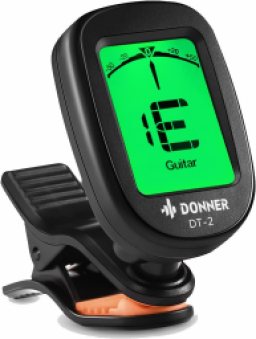
The Donner DT-2 is a good pick if you want a cheap, easy clip-on tuner for guitar, bass, violin or ukulele. It’s tiny, weighs just over an ounce, and clips on without fuss, while the vibration sensing makes it useful in noisy rooms or onstage.
The one-button setup is especially friendly for beginners, but it’s also nice for experienced players who just want a quick tune-up. The rotating display is a small but practical touch, since it helps when the headstock angle makes viewing awkward.
The main tradeoff is that it’s pretty bare-bones, and the basic display doesn’t have the polish of pricier color-screen tuners. It runs on a CR2032 battery, so that’s one more thing to keep in mind, and the build feels like a budget accessory rather than a premium tool.
Still, it’s an easy recommendation for casual players, students or anyone who wants an inexpensive backup tuner. Serious gigging musicians may want something brighter or tougher, but most buyers will find plenty to like here.
Tuner Type: Clip-on chromatic | Compatible Instruments: Guitar, bass, ukulele, violin | Tuning Range: B0–B7 | Calibration: A440 | Display: Color LCD needle display | Battery: CR2032 included
The Fender FCT-2 is a solid choice if you want a no-drama clip-on tuner for guitar, bass, ukulele or violin. It’s especially handy because it reads vibration from the instrument, so it still works well in noisy practice spaces and onstage.
The color LCD needle display is easy to check at a glance, and the dual-hinge clip should fit most headstocks without any issues. For beginners, households with a few instruments or gigging players who need fast tuning between songs, it covers the basics in a way that feels practical.
That said, it’s just a basic plastic tuner, so there aren’t many extras to get excited about. You won’t find app-like features, a rechargeable battery or a more rugged metal body here. Still, it does the job reliably, and the included CR2032 battery, A440 calibration and chromatic mode mean it’s ready to go right away.
Tuner Type: Clip-on | Compatible Instruments: Guitar, bass, violin | Display Rotation: 360 degrees | Clip: Stay-put clip | Weight: 1.58 ounces | Battery: Included lithium metal battery
The Snark SN5X is a solid choice if you want a simple clip-on tuner that’s easy to grab and use. It’s a good fit for guitar, bass and violin players who need something portable and readable between songs or during practice.
The main plus is the “stay put” clip along with a 360-degree rotating display that works for right- and left-handed players and can be viewed from either side of the headstock. It’s also tiny, weighs just 1.58 ounces and comes with a battery, so it’s ready to go right out of the box.
It is just a basic plastic clip-on, however, so don’t expect a premium feel or studio-level extras. It’s built for convenience, not polish, and the display-and-clip setup can feel utilitarian next to pricier tuners. Still, that’s part of the appeal: It's easy to use, works with a wide range of instruments and stays out of the way.
Tuner Type: Micro clip-on | Detection: Piezo vibration sensor | Calibration Range: 410–480 Hz | Display: Tri-color backlit | Adjustment: 360-degree swivel | Weight: 5.13 g
The D'Addario Micro Clip-On Tuner is a solid choice if you want a tiny clip-on tuner that stays out of the way and still does the job well.
At just 5.13 grams, it’s barely noticeable, and the piezo sensor reads vibration instead of room noise, which makes it more dependable in loud practice spaces than a phone app or mic-based tuner. The tri-color backlit display is easy to read, and the 360-degree swivel plus padded clamp help it sit where you want it.
The main downside is that this is a convenience-first tuner, so it doesn’t come with a lot of extras. However, it’s a good fit for everyday tuning, rehearsal bags and anyone who wants something accurate, portable and discreet.
Tuner Type: Pedal strobe tuner | Display: Full-color LED | Bypass Modes: Pop-less true bypass and buffered output | Connectivity: USB | Weight: 13.92 ounces
The Peterson StroboStomp HD is a solid choice for guitarists who want a pedalboard tuner they can rely on, especially if accuracy and quick, quiet tuning matter between songs.
It’s compact enough to fit into a working rig, and the bright full-color display is easy to read on dark stages or outdoors. The pop-less true bypass and buffered output options are super useful, and the variable LED backlight gives you some nice control without feeling like extra fluff. It’s aimed more at players who need dependable performance than at casual beginners.
The main tradeoff is price and size: It's a more serious tuner than a basic clip-on or tiny pedal, and it does take up more space than ultra-compact options. That makes it a tougher fit for budget setups or boards where every inch counts.
Still, it’s worth a look if you play live, tune often, or just want a no-drama tuner built around visibility and precision. Bedroom players can probably spend less, but they may also give up some of the polish and confidence this one offers.
Tuner Type: Soundhole chromatic | Compatible Instruments: Acoustic guitar, acoustic bass, ukulele | Detection: Piezo vibration sensor | Calibration Range: 410–480 Hz | Display: Color screen | Mount: Non-marring soundhole clip
D’Addario’s NS Micro Soundhole Tuner is a solid choice for acoustic players who want a tuner that stays out of the way. It clips inside the sound hole, so it’s almost invisible once it’s on, and the piezo sensor reads vibration directly from the instrument for fast, reliable tuning.
The color screen is easy to see in dim rooms, and the non-marring mount is reassuring if you’re careful about the finish. It’s especially handy for guitarists and ukulele players who like keeping a tuner on the instrument full-time.
Unfortunately, it’s not the most flexible option if you move between a lot of instruments or prefer a bigger display you can read from across the room. Still, it’s an easy recommendation for acoustic owners who want something discreet, accurate and always ready.
Functions: Tuner and metronome | Accuracy: ±0.1 cent | Tuning Range: C1–C8 | Modes: Sound Out, transpose, chromatic | Included Accessory: CM-400 contact microphone | Display: High-visibility LCD
The Korg TM-70C is a solid pick if you want one compact tool for tuning and timing. It’s a good fit for students, practice-room regulars and gigging players who need something that works across a lot of instruments.
The bright LCD is easy to read, and the included CM-400 contact mic is useful when room noise gets in the way of clip-on or built-in mics.
However, it’s a pretty plain plastic unit, so it’s built for function rather than anything fancy. There’s no app integration or extra studio-style features, and the tiny size makes it easy to misplace.
Still, the ±0.1 cent accuracy and metronome with adjustable tempo and volume make it genuinely useful for serious practice. It’s worth buying if you want dependable basics in a pocketable package, but you can skip it if you’re after a more advanced all-in-one unit.
Tuner Type: Clip-on strobe | Accuracy: 0.1 cent | Display: HD color backlit | Tunings: 65+ sweetened tunings | Battery: USB-C rechargeable | Weight: 1.3 ounces
The StroboClip HDC is a solid pick for players who want a clip-on tuner that’s genuinely precise, not just close enough. It works especially well for guitar, bass and other instruments where accurate tuning matters, including alternate tunings and capo use.
The 0.1-cent strobe accuracy is the main selling point, and the color backlit display is easy to read even in bright sunlight. At 1.3 ounces, it stays light on the instrument, and the USB-C rechargeability plus a broad set of sweetened tunings make it more versatile than a basic tuner.
This level of precision may be more than casual players need, and the interface can feel a little much if you just want something quick and simple. Clip-on strobe tuners also tend to reward careful use, so beginners who only need a basic grab-and-go option might be better off with a cheaper model. Past that, it’s a solid recommendation for practicing musicians, gigging players, and anyone frustrated by tuners that only get you “almost” in tune.
How we analyzed
We compared 30 guitar tuners across the factors that matter most in everyday use: tuning accuracy and response time, display readability, ease of setup, instrument compatibility, performance in noisy environments, build quality, power source, portability, and value.
We reviewed product specifications and owner feedback while weighing clip-on, pedal, soundhole, and desktop designs according to the players they suit best. After hours of research, we chose nine options that balance dependable performance, practical features, and price rather than favoring a single tuner style.
Main types of guitar tuners
The guitarist has six options when it comes to tuners that are physical devices: clip-on, handheld, pedal, soundhole, automatic, and rackmount tuners.
Clip-on tuners
A clip-on guitar tuner attaches to your guitar like a chip clip. It picks up the vibrations that are transmitted through the instrument when a string is played, allowing the guitar to be tuned in a noisy environment.
Handheld tuners
The size of a smartphone, these devices are a little more flexible than other options. They typically have a microphone that picks up sound as well as a 1/4-inch input jack that allows the tuner to be directly plugged into an electric or acoustic/electric guitar. Additionally, most of these tuners can generate a reference tone.
Pedal tuners
This type of tuner is designed for a guitar player who uses pedal effects. A quick stomp on the button puts this unit into bypass mode, allowing for a highly accurate tuning.
Rackmount tuners
If you use rackmount effects for your guitar or you have a studio that utilizes rackmount effects, this is the type of tuner for you. Keep in mind, however, if budget is a primary concern, rackmount tuners can be a bit more expensive than other tuners that perform similar functions.
Soundhole tuners
This type of tuner is for guitar players who like the convenience of a clip-on tuner but find the device can get in the way, get lost, or break frequently. A soundhole tuner can be permanently installed inside the soundhole of an acoustic guitar.
Automatic tuners
These devices are part robot. Typically, you affix an automatic tuner to a tuning peg, pluck the string, and let the machine do the rest. Automatic tuners are impressive, but once you are comfortable tuning your own guitar, you may want to purchase a different type of tuner.
Features to consider
Following is a list of features you need to consider when purchasing a guitar tuner. Some are options or preferences, but others are essential.
Built-in microphone
A built-in microphone can be used to tune a guitar, but other methods are preferred. It is best for woodwinds, brass, piano, and other types of acoustic instruments.
Calibration
You might hardly ever use it, but when you need it, having a tuner that can be recalibrated to a slightly different frequency is invaluable. This might happen if you are playing a gig with an acoustic piano that has slightly dropped in pitch. If you can't tune to an A that's not 440 Hz, it's not going to sound right when the instruments play together.
Chromatic tuning capabilities
A chromatic tuner lets you tune every note. If your tuner only recognizes six different pitches, at some point, you are going to outgrow it.
Detects notes
Some lower-end tuners can be very limiting — you set the note that you want to tune to and then go for it. It might not even register as sharp or flat until you are close, which could lead to broken strings. It is faster and easier to tune with a unit that can tell you exactly where you are at all times.
Durable
You want a tuner that can handle the rigors of the road and an accidental bump or two. Otherwise, you'll be buying a lot of tuners.
Ease of reading
You need a tuner that is easy to read. Choose whatever works best for you, whether it has a monochrome meter, bright colors, a strobe, or something else. We recommend selecting a tuner that is visible in all lighting situations and at a wide variety of angles.
Fast and accurate
It goes without saying that you need a tuner that is consistently accurate. Having one that processes information rapidly is also desirable. If it takes a couple seconds for the tuner to keep up with what you're playing, you may end up improperly tuned … and frustrated.
Input jack
A tuner with a 1/4-inch input jack is ideal for electric or electric/acoustic guitars. This allows you to plug your guitar directly into a tuner so you can check the tuning at any time.
Lightweight
If the unit fastens to your guitar, you'll want it to be light enough that you don’t notice it while playing. However, if it's a pedal box, weight won't be as much of a concern. You might even prefer something heavy because you'll constantly be stomping on it.
Polyphonic
Polyphonic tuners allow you to strum your guitar to see at a glance which strings are out of tune. This type of tuner can be handy, but it is unnecessary — it’s more of a bell or a whistle than an essential feature.
Vibration sensing
A tuner that can sense vibrations from your guitar can be used in a noisy environment. This is desirable because it can be impossible to get silence in a rehearsal or performance situation. However, a vibration-sensing tuner is not your only solution to this problem. A tuner with a 1/4-inch input jack would also work.
Guitar tuner prices
A guitar tuner can range from $4 to over $100. In that first range, from $4 to $10, expect no-frills clip-on models that are monochromatic, possibly slow to respond, and might not be able to handle alternate tunings. Guitar tuners in the range of $10 to $25 have brightly colored displays, feature a faster response, may detect all frequencies, and can be calibrated for fine-tuning. In the $25 to $50 range, the tuners are standalone handheld units that include all the bells and whistles. These units are also likely to have a microphone to make the unit effective for brass, woodwind, piano, and other acoustic instruments. Once you move past $50 and start getting closer to $100, you're approaching the realm of pedal effects, soundhole tuners, rackmount tuners, and even automatic tuners.
Tips for tuning your guitar
Tuning a guitar is a fairly straightforward process: you play a note, look at the tuner, then tighten or loosen the string accordingly. The biggest mistake beginners make is turning the pegs too much. It is easy to become impatient and frustrated and make a flat note sharp or a sharp note flat. The best approach is to drop the tuning (make the string flat), then raise it slowly and steadily until it is in tune.
Once you get the hang of tuning, your approach may change, but for now, here are some tips to minimize those initial frustrations.
-
Be sure you are tuning the right string. The natural instinct is to twist the tuning peg more frantically when it doesn't immediately register a change on your tuning device. Often, this is because the guitarist inadvertently grabbed the wrong peg. This can easily result in a broken string.
-
Always tune up. Loosen the string you are tuning until it is flat. Then, approach the proper tune by tightening the string. This method helps keep strings from slipping flat while you’re practicing or performing.
-
Always use smaller motions. It doesn't take much twisting to get a guitar back in tune. If you tune aggressively, it is easy to over-tighten your strings. This could result in many snapped high E strings before you learn a softer approach.
-
Give the tuner a minute to determine the initial pitch. A note is actually made up of several frequencies, so it might take lower-end tuners a moment to determine which string you are actually playing. Don't get mad at the tuner. Try playing louder or softer until the tuner correctly identifies the note.
-
Give your tuner a moment to catch up to your tuning. Sound is a fluctuating frequency. You may have to let the tone ring for a brief period after adjusting the tuning peg to get the correct reading on your tuner.
-
Don't play the note you are tuning too aggressively. How hard you pick or pluck the string will momentarily affect the pitch.
FAQ
Q. How often do I need to tune my guitar?
A. A guitar is not like a piano; it doesn't hold its tune for months at a time. Set yourself up for good habits by tuning your guitar every time you pick it up for a session, whether it's a jam session, a songwriting session, a practice session, or a performance. Then, keep your ears focused on your music because it is possible you will need to tune your guitar during the session as well.
Q. How often should I change my strings?
A. The answer to this is a matter of personal preference. Ideally, you should be able to get about three months out of a set of strings. However, if you play every day, that might be too long. You will begin to notice a buildup of dirt, oil, and dead skin cells on your strings that makes them feel and sound a little lackluster. Once this happens, it's time for new strings. Alternatively, you could try cleaning your strings and fretboard with a dry cloth, but usually, a string change is the most effective solution.