Buying guide for best sergers
Ready to buy now? Shop the best:
My sister has loved sewing since she was a kid. Our school made all eighth graders take a semester of sewing, and she excelled at every project. From holiday pillows that our mother put on the sofa every Christmas to a denim purse that she gave her best friend as a gift to a polka-dotted elastic waist skirt that I was thrilled to get as a hand-me-down several years later, she had a gift right from the start.
She's continued to make fun decorative pillows over the years, but her best projects are usually her clothing pieces, including the adorable blue-striped knit cardigan she made for me last summer. When I've asked her how she manages to make such high-quality clothing herself, she always says that it all comes down to her serger.
If you’re serious about sewing, a serger is a great tool to have because it creates overlock stitches using multiple threads. Though it isn't as versatile as a sewing machine, it is the easiest way to create a durable, elastic overlock stitch. It also works much faster than a sewing machine and gives your creations a tidy, professional look.
The number of threads a serger can handle varies; most machines handle two to four threads. They usually include a variety of stitch types, too, by varying the tension and stitch length. That's why it's important to have a clear idea of what projects you will use your serger for before you pick out a model.
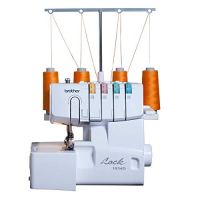
At BestReviews, we've researched and analyzed dozens of sergers to help us identify the best machines. Our top pick, the Brother Heavy-Duty Serger, offers excellent speed, delivering 1,300 stitches per minute. It is easy to thread, too, thanks to its color-coded upper thread guide and lower looper threading system.
Serger vs. sewing machine
What's the difference between a serger and sewing machine? It's a common question, especially from people looking at these machines for the first time.
- A sewing machine is a superb all-rounder. It can perform all kinds of tasks beyond just sewing two pieces of material together, but it normally does so with one thread and one needle.
- A serger, or overlock machine, is a specialist tool. It may have one or two needles and the capacity to sew with anywhere from two to eight threads.
- Because it uses multiple interlocked threads, there's a certain amount of “give,” or elasticity, in a serger seam. An ordinary sewing machine seam tends to pull at knits and delicate fabrics.
- A serger can cut excess material away from a seam as you work. The blade is right by the needles, so it makes for a really neat finish. (You can turn it off or remove it if you don’t want this function.)
- Sergers work quickly. A typical sewing machine runs at around 600 stitches per minute. The slowest serger featured on our list, the American Home, runs at 1,100 stitches per minute. The fastest on our list, the JUKI, can complete 1,500 stitches per minute.
Even the best serger will not replace your sewing machine entirely. Although they can do it, most are not great for zippers or buttonholes, and no serger can perform top-stitching.
3/4 serger vs. 2/3/4 serger
The numbers above represent the number of threads a particular machine uses to create a stitch. It stands to reason, then, that a 2/3/4 serger offers more stitch variety that a 3/4 serger. However, two-thread stitches are more specialized (you can use them for creating a rolled hem, for example), so for many consumers, a 3/4 machine is all that is needed.
On the surface, that would suggest that the 2/3/4 sergers gives your more choice. But there's much more to choosing the best serger than the number of threads it uses.
Stitch versatility
Professional garment makers tell us that the most important single feature in serger stitching is differential feed. It controls the speed at which your material passes beneath the presser foot. It's vital for creating gathers and for the successful serging of fabrics without pulling. All of the sergers that made our final review have this feature.
A serger gives you control of thread tension and stitch length, but does not necessarily give you control of stitch width. Additionally, most manufacturers will make your life easier by providing a number of pre-sets for things like rolled hems.
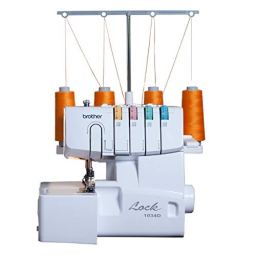
Despite the fact that it’s a 3/4 machine, the Brother 1034D offers 22 stitch types, making it by far the most flexible serger of our final five. In fact, although this is a fairly low-cost machine, it's a feature you'll find hard to beat at any price.
Threading complexity
Is a serger difficult to thread? In truth, this can be one of the most intimidating aspects of using a serger. One thread is difficult enough; with a serger, you’ve got four to deal with!
Manufacturers understand this, but unless you're spending thousands of dollars on a professional machine that uses jets of air to blow the threads through, you’ll probably need a little time to get used to the threading process.
Colored thread paths and printed charts can help you along. Instructional DVDs are common, and there are numerous online videos at YouTube and other sites. Some sergers even come pre-threaded, which is great for beginners.
Control
A free arm is a must-have if you work with sleeves and cuffs.
A foot control (similar to what you’d see on an ordinary sewing machine) gives you speed control and keeps your hands free.
All sergers have knives to cut away extra fabric, but the amount of control you have is often minimal.
Useful accessories
Sergers come with a variety of accessories: screwdrivers for changing needles, tweezers, oil, a cleaning brush, a hex wrench, sometimes a pair of scissors.
However, while most of these things are nice to have, it's unlikely you'd find anything in the accessory realm that would “make or break” your serger choice.
Price
How much should you expect to pay for a serger? It's difficult to find a capable all-rounder for under $150, though prices do fluctuate, and there are often sales or promotions you can take advantage of.
Professional sergers can easily cost ten times that amount, though it's our opinion that most home users can get the machine they need for less than $400.
The quality question
Many sergers come from companies you already recognize as makers of sewing machines or other home electronics. Others may not be so well known, but take a glance at these machines, and they look remarkably similar.
So how do you differentiate the good from the mediocre?
- Owner feedback can be an excellent guide, though you do need to be careful. People are quick to complain but slow to compliment, and that can skew the results.
- Warranty information is a good indicator of a manufacturer’s confidence in its product. But again, caution is needed. The casing of a machine might have a 25-year warranty, whereas the internals (the parts more likely to break down) may only be guaranteed for 12 months. In some cases, this warranty can be as short as 90 days.
- Price also provides an indication of worth. Costlier machines generally have more metal parts inside. Cheaper ones use more plastic. You would expect the former to last longer, but there's no hard and fast rule. A machine’s longevity and durability also depend on how often you use your serger and whether you work primarily with delicate or heavy fabrics.
FAQ
Q. What's a good first serger for making clothes?
A. The Brother 1034D is our pick for home sewers who want to finish seams and work with knits without moving to a professional machine. Its color-coded threading guides help you learn the thread paths, but you'll still need practice threading the loopers in the right order and balancing tension. Start with scraps from your project, sew slowly, and check the seam before trimming your garment. A fast stitch rate is useful once you're comfortable; it doesn't have to dictate your learning speed.
Q. How do I keep stretchy fabric from coming out wavy?
A. Look for differential feed, which lets you adjust how the machine moves fabric under the presser foot. The Singer S0100 and Singer HD0450S both offer this adjustment, so you can compensate when a knit stretches or a lightweight fabric puckers. Test the setting on a scrap with the same number of layers as your seam, and let the machine feed the fabric rather than pulling it. Thread tension and stitch length also matter, so change one setting at a time.
Q. Do I need a coverstitch machine as well as a serger?
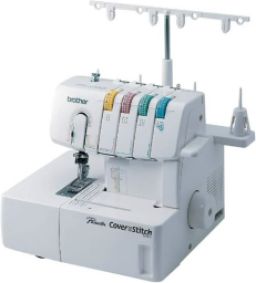
A. That depends on the finish you want. A conventional serger trims and overcasts a fabric edge, while a coverstitch machine makes the parallel rows of stitching commonly seen on T-shirt hems. The Brother 2340CV is a dedicated coverstitch option for hemming stretch garments; it doesn't replace an overlock serger for trimming seam allowances. If you mostly sew woven projects and finish raw edges, start with a serger. Add coverstitch capability when knit hems become a regular part of your sewing.
Q. Can one machine handle overlock and coverstitch work?
A. The Singer Professional 14T968DC combines overlock and coverstitch functions, making it useful if you want both finishes but don't have room for two specialty machines. The tradeoff is setup: switching techniques means changing the threading and machine configuration rather than simply moving to another machine. That's manageable if you batch similar seams together. If you switch between joining seams and hemming throughout a project, separate machines can save time even though they take up more space.
Q. What should I look for if I have a small sewing space?
A. The Janome MOD-8933 is a compact option with three- and four-thread stitching and differential feed, so a smaller machine doesn't have to mean giving up the basics for garment construction. Leave enough space around it for fabric to move freely and for you to reach the threading paths. Also consider where you'll put the thread cones, foot pedal, and trimmed fabric. A machine that fits on a shelf may still need more working room than its footprint suggests.