Buying guide for best shooting earmuffs
Ready to buy now? Shop the best:
Whether you shoot for fun or competition — or even for your profession — safety matters. That includes ear protection.
Did you know just a single unprotected gunshot can cause permanent hearing loss? That’s why wearing the best shooting earmuffs is critical. With acoustic sealing and advanced noise-canceling technology, they protect your ears from the excessively loud, sharp noise of every shot.
We researched the top options on the market and found the Walker's Razor Slim Earmuffs to be the best. They offer excellent sound reduction, a lightweight design and cushioned earcups for maximum comfort.
Editors’ picks
Walker's Razor Slim Earmuffs
Editors’ Favorite
Noise Reduction: 23 dB | On-Board Controls: Yes | Power Source: 2 x AAA batteries | Noise-Cancellation: Yes | Sound-Activated Compression: 0.02 seconds
With an ultra-low profile and a folding mechanism, the Walker’s Razor Slim Earmuffs are great for traveling, and you’ll barely feel them on your head while at the shooting range. They offer a 23-decibel noise reduction and compression that activates in just 0.02 seconds after detecting gunfire.
They’re effective for both indoor and outdoor shooting ranges, and the cushioned earcups make them comfortable enough to wear for extended periods. You can still hear around you while they suppress loud gunshot noises, including people talking or even whispering, and you can communicate with all other shooters well.
These earmuffs are well-built and significantly cheaper than other sets that offer comparable performance. Noise suppression is fantastic, and on-board volume controls make it easy to adjust how much external noise you can hear.
Walker's Compact Folding Hearing Protection Muff
Great Value
Noise Reduction: Not available | On-Board Controls: Yes | Power Source: 2 x AAA batteries | Noise-Cancellation: No | Sound-Activated Compression: 0.02 seconds
The great thing about the Walker’s Compact Folding Hearing Protection Muff, aside from their low $25 price tag, is how surprisingly effective they are, thanks to split-second, sound-activated compression. That means that in just 0.02 seconds after detecting gunfire, they start working their magic, keeping your hearing protected the entire time you’re at the range.
The rugged housing makes them highly durable, and the noise suppression is excellent. Onboard volume controls let you easily adjust how much external sound comes through your earmuffs, and the integrated omnidirectional microphone lets you hear when the person next to you is saying.
While they don’t offer active noise cancellation like some other high-end shooting earmuffs, these are perfectly fine for occasional days at the range. The comfort and low price alone make them worth it for casual shooting range activities.
Walker's Unisex Adult Razor Quad Muff
Best with Bluetooth
Noise Reduction: 23 dB | On-Board Controls: Yes | Power Source: 2 x AAA batteries | Noise-Cancellation: No | Sound-Activated Compression: 0.02 seconds
If you’re looking for earmuffs that’ll let you stay connected while at the shooting range, the Walker’s Unisex Adult Razor Quad Muffs are equipped with Bluetooth connectivity, so you can take calls and receive alerts without having to actually use your phone.
They feature a sound-activated compression time of 0.02 seconds and noise reduction of 23 decibels, which is slightly better than many others with a 25-decibel rating. They have two separate knob controls, one for Bluetooth volume and the other for external noise management, and 360-degree sound capture via the built-in mic so you can hear what others around you are saying.
Bluetooth connectivity is a neat feature that many will appreciate, and its comfortable yet durable build makes these earmuffs a great option if you frequently hit the shooting range.
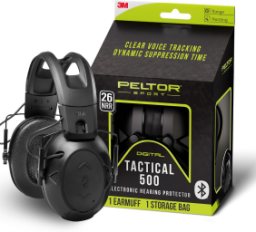
Peltor 3M Tac 500
Best for Indoor Shooting Ranges
Noise Reduction: 25 dB | On-Board Controls: Yes | Power Source: 2 x AA batteries | Noise-Cancellation: No | Sound-Activated Compression: 1 millisecond
There is a difference in the acoustics of indoor and outdoor shooting ranges. The Peltor 3M Tac 500 earmuffs are optimized for indoor ranges, and they’re among the best options for extended sessions or for anyone who goes to the range often.
They offer 25-decibel noise reduction and extremely fast sound-activate compression at 1 millisecond, which is essentially instant. Clear Voice Tracking filters out unwanted background noise while letting you hear people’s voices, so you can engage in conversation without taking off your earmuffs. The low-profile design and adjustable headband mean you’ll get a personalized fit for added comfort.
These earmuffs are more expensive than most of our other picks, but they’re worth it for anyone who visits an indoor shooting range often.
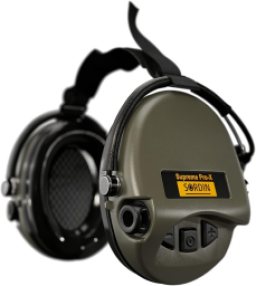
Sordin Pro-X Earmuffs
Best Splurge
Noise Reduction: 25 dB | On-Board Controls: Yes | Power Source: 2 x AA batteries | Noise-Cancellation: Yes | Sound-Activated Compression: Instant
The high price tag of the Sordin Pro-X Earmuffs makes them unsuitable if you only go to the range just once or twice a year. However, for any shooting-range enthusiast who wants instant sound compression and top-tier protection, these earmuffs are second to none.
These earmuffs effectively drown out loud gunfire noise but keep people’s voices clear and audible so you can converse with those around you without yelling. There are four modes: hunting, focus, shooting and communication, each with a preset profile optimizing sound suppression and voice clarity to comfortable levels.
If you only visit the shooting range once in a while, we recommend looking into one of our other picks. But outdoor sports shooters and hunters will love that they can hear game while suppressing the noise of gunfire.
How we analyzed
Most of our top picks serve one fundamental purpose: suppressing gunfire noise. While they all get the job done, our list is diverse, featuring a range of products suitable for both casual and hardcore shooting-range enthusiasts. We evaluated the pros and cons of different types of earmuffs as well as the noise reduction rating and overall design of each pair. We found that the best earmuffs offer fast sound compression, active noise-cancellation and make it easy to hear others.
Types of shooting earmuffs
Passive
Passive earmuffs are made from foam and plastic. They reduce all noise.
When wearing passive earmuffs, it’s difficult to talk with the people around you, as a person’s voice will be reduced by the same amount as a loud gunshot.
Electronic
Electronic earmuffs reduce noise in the same manner as passive earmuffs. However, electronic muffs include small microphones and speakers. They can distinguish between loud noise (like a gunshot) and quiet noise (like a voice).
Electronic earmuffs amplify quiet noise to emulate “normal” hearing while protecting you from louder sounds.
Noise reduction rating (NRR)
You can use a product’s NRR, or Noise Reduction Rating, to judge the effectiveness of shooting earmuffs. Subtract seven from the NRR, then divide by two to find out how many decibels the earmuffs cancel out. For example, an NRR of 37 will cancel 15 decibels.
Check product details carefully to distinguish between Noise Reduction Rating and a overall decibel reduction. For example, if the package says the earmuffs reduce noise by 30 decibels, the NRR is 67.
Conversational voices are typically 60 decibels. A food processor produces about 95 decibels. Any sound above 120 decibels is considered harmful to the ear, especially during prolonged or repeated exposure. Gun shots range from 145 to 190 decibels.
Proper fit
Shooting ear muffs must fit properly to be effective. Weight, adjustment, and flexibility each influence the fit of your earmuffs.
Weight is particularly important. Lighter earmuffs are preferable, since heavy earmuffs grow uncomfortable after prolonged use. When earmuffs are uncomfortable, the wearer tends to adjust them, and adjustments can reduce the effectiveness of the seal around the ears. Walker's Game Ear and Pro For Sho are two shooting earmuff manufacturers that make notably lightweight models.
The ear cups on shooting earmuffs are attached by an adjustable plastic strap. A strap with a greater range of motion and flexible material is easier to fit properly and is likely to feel more comfortable when it is worn.
Price
How much should you expect to pay for a decent pair of shooting earmuffs?
You can find lots of great models that cost far less than $100. In fact, many good choices cost less than $20.
If you’re looking to buy from a line of top earmuffs like Honeywell’s Howard Leight selection, expect to find a range of choices that extend up to more than $50. These earmuffs are marketed for both commercial and consumer applications.
Another notable manufacturer, Walker’s Game Ear, offers a Razor series with prices hovering around the $70 mark. These are great muffs, but you can also find an excellent pair of Walker’s earmuffs that cost closer to $15.
In short, it pays to shop around. As mentioned above, passive earmuffs may cost less than their electronic counterparts.
Other considerations
Don’t forget the batteries
Electronic shooting earmuffs require a battery to power the microphone and speakers.
Some electronic ear muffs contain a dedicated battery, which is charged using a standard USB cord.
Use your shooting earmuffs in additional situations
At 145 to 190 decibels, gunfire is louder than many other harmful sounds. If your shooting earmuffs fit comfortably, you can get more from them by using them during other activities, such as mowing the lawn or working with power tools.
Some shooting ear muffs can play music
A few electronic models on today’s market provide a 3.5mm headphone jack. You can plug in your smartphone or mp3 player and listen to music while you shoot.
FAQ
Q. Do shooting ear muffs completely cancel noise?
A. Shooting earmuffs aren’t designed to completely block out sound. Check the Noise Reduction Rating (NRR) to determine how much noise reduction each model offers.
Q. How do electronic shooting earmuffs enable me to hear quieter sounds?
A. First, electronic shooting ear muffs reduce all sound in the same manner as passive ear muffs: layers of padding physically block out harmful decibel levels. However, electronic shooting earmuffs capture all sounds via a set of microphones. A microchip determines the decibel level of the incoming noise; if it’s below the “quiet” threshold, the noise is passed to amplifying speakers inside the ear cups.
Q. How do I know when it’s time to change the battery?
A. Electronic shooting ear muffs include an indicator LED that lights up when the battery needs to be replaced or recharged.