Buying guide for best robot mops
Ready to buy now? Shop the best:
Robot mops have come a long way, and we don’t just mean across your kitchen floor. From being newfangled devices at the dawn of the robot cleaning era, to today’s hands-off, all-in-one models, robot mops have quickly become must-have devices for the home. The best robot mops know what kind of floor they’re on, lift spills and stains without help, and wash and dry themselves.
The BestReviews Testing Lab has spent a lot of time testing robot mops and vacuums over the years. We’ve looked at standalone robot mops as well as all the versions of combo mop-and-vacuum robots, from simple wet pads to the latest roller and rotary pad technology. We keep up to date with the ever-changing market for robotic cleaning devices, and we’ve assembled a list of top robot mop and vacuum models that our experience and testing tell us offer effective automated mopping at different price points.
Our top pick currently is the Dreame L40 Ultra Gen 2 Robot Vacuum and Mop, which uses powerful suction and mopping to bring you excellent results on all kinds of flooring. But whether you want a simpler budget model or one with all the bells and whistles, this guide will help you find the robot mop that’s right for you.
Editors’ picks
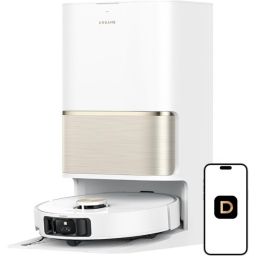
Dreame L40 Ultra Gen 2 Robot Vacuum and Mop
Best for Whole Home Cleaning
Robot Height: 3.8” | Mopping Pad Type: Rotary | Battery Life: 231 min | Suction: 25,000 Pa | Self-Cleaning: Yes
You’ll rarely need to think about your floors when you have the smart Dreame L40 Ultra Gen 2 Robot Vacuum and Mop by your side. Offering up to 100 days of hands-free cleaning, it keeps floors clean with a powerful combination of strong suction, four carpet-cleaning modes and precision mapping, so every nook and cranny of your home is covered.
Boasting a super long battery life, it can clean for up to 231 minutes in Quiet Mode before returning to its self-cleaning dock, where its parts are washed, dried and emptied. It offers five suction modes and 25,000 Pa of suction to suck up pet hair, dust, debris and other messes with ease. And it can extend its brush and mop to reach all those tough-to-clean spots, like corners, edges and under furniture.
Excellent news for pet owners is its pet-zone cleaning customization and ability to avoid obstacles. Which means it won’t disturb your pet’s things or run over any pet accidents. Making it even easier is the Dreame app, which lets you control it from anywhere, and voice control, which can be used with Alexa, Siri and Google Home. It’s also reasonably priced for everything that comes with it, but note that the auto-detergent dispenser for mopping is sold separately.
Yeedi M14 Plus Robot Vacuum & Mop
Best for Homes with Carpet
Robot Height: 3.86” | Mopping Pad Type: Roller | Battery Life: 241 min | Suction: 18,000 Pa | Self-Cleaning: Yes
Yeedi has established a position for itself in the robot mop industry with cost-conscious models that still deliver high-end innovations. The Yeedi M14 Plus Robot Vacuum and Mop is a recent model that offers a roller mop design with high suction force and a versatile approach to rugs and carpets.
The Yeedi M14 Plus features a roller-type mop, which, like similar competitors, is constantly cleaned and refreshed with clean water from its onboard tank while in motion. The Yeedi’s roller spins at 200 rpm for strong scrubbing action with 16 times more downward force than earlier Yeedi models. Most impressively, the mop roller can extend outward to mop within 1 millimeter of a wall for a more comprehensive mopping run. And when it’s time to move from hard surfaces to carpeting, the mop can lift 0.39 inches. It can even mop and vacuum plastic utility mats while avoiding high-pile rugs.
When it comes to vacuuming, the Yeedi boasts a maximum of 18,000 Pa of suction. It has active obstacle avoidance and the ability to clean along a curve. Its large, streamlined dock empties its dust cup, washes its mop and offers heated mop drying.
Dreame X60 Max Ultra Complete
Best Premium Robot Mop Combo
Robot Height: 3.13” | Mopping Pad Type: Rotary | Battery Life: 180 min | Suction: 35,000 Pa | Self-Cleaning: Yes
The Dreame X60 Max Ultra Complete is one of the most powerful robot mops and vacuums on our list. With 35,000 Pa of suction, it delivers as much power as some full-size vacuums. This power allows it to deep-clean carpeting as a vacuum, but also handle wet messes and help hard floors dry more quickly as a mop. Its two microfiber mop pads also provide 15 newtons of pressure and spin at 230 revolutions per minute, so it can remove even the most stubborn, sticky, greasy stains.
The X60 Max Ultra’s 10-in-1 dock handles all the dirty maintenance tasks for you. It automatically empties the dustbin for over three months, uses 212-degree water to wash the mop pads and dries them with hot air. It also features a built-in dual-solution compartment that automatically refills the mop with water and cleaning solution.
However, the X60 Max Ultra’s best feature may be its thinness. At just over 3 inches high, it can easily slip under most couches, beds and coffee tables with under-storage. It can get into those tight areas without getting stuck and even features dual AI cameras to detect obstacles and navigate around them for truly efficient mopping.
Dreame L50 Ultra
Best Autonomous Robot Mop
Robot Height: 3.8” | Mopping Pad Type: Rotary | Battery Life: 200 min | Suction: 19,500 Pa | Self-Cleaning: Yes
The Dreame L50 Ultra can thoroughly mop all your hard floors because it easily passes over door tracks. Its ProLeap system retracts the robot’s legs, which allows it to glide over thresholds and other obstacles without missing a beat. It also uses AI and 3D structured light to establish smart cleaning paths and avoid obstacles, such as cables, furniture legs, shoes and more.
In addition to mopping, the L50 Ultra vacuums, allowing it to clean all your home’s floors. It provides 19.500 Pa of suction power, so it can pull embedded dirt and pet hair from carpeting with ease and remove liquid messes from hard surfaces. The robot is especially effective for cleaning corners because it has an extendable side brush and mop that can reach into tight areas.
The L50 Ultra’s all-in-one dock keeps maintenance to a minimum, too. Not only does it self-empty the robot’s vacuum dustbin for up to 100 days, but it also rinses the mop pads with hot water and dries them with hot air. It even refills the robot with water and cleaning solution, so it’s always ready to clean.
Dreame D20 Air Plus
Simple Yet Solid
Robot Height: 3.81” | Mopping Pad Type: Pad | Battery Life: 150 min | Suction: 20,000 Pa | Self-Cleaning: No
The Dreame D20 Air Plus is a great robot vacuum with a simple mop attachment that’s adequate for essential tasks. While it won’t scrub deeply into your floors, it should keep surfaces free of dust and dirt, especially paired with its powerful suction.
With 20,000 Pa of suction, the D20 Air Plus is comparable to robot vacuum and mops at much higher price points. In fact, it’s in the same ballpark as many stick and upright vacuums. Its mop attachment holds 280 milliliters of water and, unlike some basic mop systems, has 32 water levels that you can set in the Dreame smartphone app. The tougher the stains, the wetter you can set the Air Plus’s pad.
The Air Plus has a self-empty dock that’s just for storing dirt. There’s no mop washing or refilling, which you’ll have to do yourself, and you also need to wash the microfiber mopping pad in the washing machine every so often. The Air Plus has a comfortable 150-minute battery life, a single brush roller and an extendable side brush for getting into corners and along walls, so even hard-to-reach spots are left sparkling clean.
roborock Qrevo Curv 2 Flow Robot Vacuum & Mop
Best-in-Class Cleaning Performance
Robot Height: 4.7” | Mopping Pad Type: Roller | Battery Life: 242 min | Suction: 20,000 Pa | Self-Cleaning: Yes
The Roborock Qrevo Curv 2 Flow is our editors’ favorite among mopping robots. It’s got a constant-refresh roller mop, an attractive multifunctional dock, powerful 20,000 Pa suction and active object recognition. It can also recognize your pets and work as a pet monitor when you’re not at home.
The Qrevo Curv 2 Flow is a roller-style mopping robot and vacuum. This roller mop exerts a downward force of 15 newtons for improved scrubbing performance on tough, sticky stains, like dried juice or condiments. It’s also continuously cleaned and refreshed with water, cutting down on spreading spills during a mopping job.
The mop roller can clean as close as 10 millimeters to a wall, and it features a physical shield when crossing onto carpet to keep rugs dry. As a vacuum, it features a split roller brush to let hair pass through without tangling, and impressive navigation and object recognition for real-time obstacle avoidance and mess detection. It also can use its camera and speaker to find your pets for a video chat.
The Curv 2 Flow’s rounded dock is one of those rare robot docks that doesn’t look hideous out in the open. It’s also enhanced with a dock tray that keeps dirty and fresh water separate while cleaning the mop roller. It dries the mop with 137-degree warm air and intelligently detects dirt level for cleaning and washing, in addition to holding more than two months’ worth of dirt for emptying.
Tapo LiDAR Smart Navigation Robot Vacuum and Mop
Best Low-Cost Auto-Emptying Vacuum
Robot Height: 3.9” | Mopping Pad Type: Rotary | Battery Life: 120+ min | Suction: 5,300 Pa | Self-Cleaning: No (only self-emptying)
If you’re looking for quality at an affordable price, the Tapo LiDAR Smart Navigation Robot Vacuum and Mop is a no-brainer. This powerful machine effectively picks up dirt and debris on hard surfaces and low-pile carpeting while getting floors sparkling clean with its mopping capabilities.
Using mesh grid technology, it cleans in a grid pattern so it never misses a spot. It automatically boosts suction when it’s on carpeting and knows to avoid carpeting when in mopping mode. When it’s done vacuuming, it empties itself into the dock that holds up to 60 days’worth of debris.
Customers say it’s fairly quiet and easy to set up. And to make life even easier, it’s compatible with Alexa and Google Home, and cleanings can be scheduled via the Tapo app.
eufy Omni C20 Robot Vacuum & Mop Combo
Best Self-Cleaning Mop System for the Price
Robot Height: 3.35” | Mopping Pad Type: Rotary | Battery Life: 101 min | Suction: 7,000 Pa | Self-Cleaning: Yes
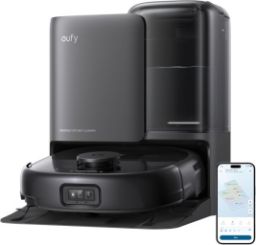
We’ve had positive experiences with eufy robot vacuums and mops in the past, appreciating their wealth of features and their competitive prices. The eufy Omni C20 Robot Vacuum and Mop is a perfect example, with several sought-after features priced to move.
The Omni C20 features rotary disc mopping that can agitate and scrub effectively compared to older pad-based mopping robots. Each disc spins at 180 rpm with 6 newtons of downward force, allowing it to scrub many flooring types and lift dried dirt or stains. The C20 can lift its mopping discs 0.41 inches as well while transitioning to rugs and carpets to help keep them dry while vacuuming.
As a vacuum, it features 7,000 Pa of suction, with a roller brush that rotates against a comb to detangle as it works. We also appreciate that the C20’s turret-less vertical profile is only 3.35 inches, allowing it to clean under couches and dressers most other robot mops and vacuums can’t.
The Omni C20 has a large, relatively pleasantly designed all-in-one dock with curving edges to its clean and dirty water tanks. Note that each tank is translucent with large status lights at its base, which may or may not be welcome in your room. The dock cleans and refills the C20 but only uses room-temperature air while drying.
eufy Omni E25 Robot Vacuum and Mop
Best for Pet Owners
Robot Height: 4.4” | Mopping Pad Type: Roller | Battery Life: 200 min | Suction: 20,000 Pa | Self-Cleaning: Yes
The eufy Omni E25 is a solid cleaner with an excellent roller-style mop. We tested this model ourselves and found it highly convenient thanks to its smart navigation and object recognition.
The E25 is a squarish robot with two side brushes, letting it get close to corners and edges. It has a flat top, but we found it still a bit too thick to fit under a couch. Its mopping was impressive, with a roller mop capable of 12 newtons of pressure that effectively absorbed fresh spills without splashing them around the room. It lifted its mop smartly to avoid carpets, even round rugs, and it continually washed and scraped its roller during use, cutting down on dock visits.
It was a solid vacuum, with 20,000 Pa of suction somewhat hamstrung by a split single roller. Its dock features automated mop washing and heated mop drying, and it comes with a bottle of pleasantly scented mopping solution that the dock dispenses automatically.
Mova P10 Pro Ultra Robot Vacuum & Mop
Most Intelligent
Robot Height: 3.81” | Mopping Pad Type: Rotary | Battery Life: 198 min | Suction: 13,000 Pa | Self-Cleaning: Yes
Mova is a value-oriented brand associated with Dreame, maker of high-end robot mops and vacuums. It’s popular with buyers thanks to its mid-priced robots like the Mova P10 Pro Ultra Robot Mop and Vacuum that deploy many high-end innovations and intelligent features.
The Mova P10 Pro Ultra features rotary-style mopping discs that can reach 4 centimeters away from the body, allowing it to mop close to walls and reach slightly underneath overhangs. It features smart dirt sensing that lets it recognize a tough stain or spill and intelligently return to it for extra attention without any input from the user. By the same token, it also intelligently washes its mop on its own during heavy jobs. It recognizes some 70 objects with its AI visual system, and it can detect and suggest the best ways to clean a given room, including ones with pets. The P10 Pro Ultra’s vacuum features 13,000 Pa of suction and a fully rubber roller that can get deep into carpets when needed.
The Mova P10 Pro Ultra’s dock is visually mostly unremarkable, but does all its jobs well, including 70-degree heated mop washing and mop drying. It supports optional plumbing hookups for fully automated tank filling and emptying as well. It even comes with its own built-in voice assistant.
Dreame L50 Ultra Robot Vacuum & Mop
Best-In-Class Stain Removal
Robot Height: 3.5” | Mopping Pad Type: Rotary | Battery Life: 200 min | Suction: 19,500 Pa | Self-Cleaning: Yes
The Dreame L50 Ultra is the top mopping robot in our roundup. It impresses with its corner and edge cleaning, carpet care and self-cleaning and in its ability to surmount thresholds of 2 inches or more.
Like many robot mops, the L50 Ultra uses spinning rotary mop pads for cleaning hard floors. These mop pads can lift 10 millimeters to avoid carpets automatically, while on spills its vacuum rollers and side brush can also lift to avoid tracking liquid.
One mop pad can also extend to mop along edges and in corners. The mops are magnetically attached and can be left behind completely if the L50 Ultra is on a carpet-only run. It can even wipe spills off rubber mats.
The L50 Ultra can climb over thresholds of 1 and a half inches in a single step or over 2 inches in two stages, allowing it to clear horizontal furniture feet, cable shields and other obstacles. Its dock has a flat mop washing station to avoid residue buildup and rinses its mop pads with 165-degree water.
As a vacuum, the L50 Ultra has impressive dirt pickup thanks to its pair of converging rollers, one of which features bristle brushes to dig into carpet. It has advanced AI-powered object recognition and can go back to clean and mop spots that need extra attention without any input from the user.
Dreame L10s Ultra Robot Vacuum & Mop Combo
Best Self-Cleaning Mop System for the Price
Robot Height: 3.8” | Mopping Pad Type: Rotary pad | Battery Life: 210 min | Suction: 5,300 Pa | Self-Cleaning: Yes
For a full-featured robot mop and vacuum, consider the Dreame L10s Ultra. This model offers solid performance in both vacuuming and mopping along with a comprehensive self-cleaning and maintaining dock at an appealingly modest price point.
The Dreame L10s Ultra is a rotary pad mopping robot and vacuum whose pads spin at 180 rpm. It offers 30 different options for water flow, from minimal to extensive, and it can raise its mop pads 7 millimeters to clear low-pile rugs and carpets. Its dock capabilities impress at its price, with auto-washing, hot-air drying, and optional automated mop-solution dispensing.
As a vacuum, the L10s features 5,300 Pa of suction, which is a little low for current-generation models, and only a single roller brush, so it’s best for daily light pickup. The roller brush’s fins are diamond-contoured, however, to assist in agitation while avoiding hair tangles.
ECOVACS DEEBOT X9 PRO Omni Robot Vacuum & Mop
Best for Homes with Minimal Carpet
Robot Height: 3.8” | Mopping Pad Type: Roller | Battery Life: 200 min | Suction: 16,600 Pa | Self-Cleaning: Yes
A premium level robot, the Ecovacs Deebot X9 Pro Omni is our pick for homes with mostly hard flooring. Its roller mop is well suited for cleaning all sorts of sealed hard flooring and can extend itself to mop against walls and into corners.
The Deebot X9 Pro’s roller mop design allows it to self-clean continually while mopping, helping prevent spreading spills and cross-contamination. Its roller mop is slightly off-centered and extends itself several inches to clean along walls. The X9 Pro’s AI allows it to detect areas that need extra mopping and then works on them again without prompting.
It can lift its mop roller 0.39 inches when vacuuming short-pile carpet, and can even vacuum and mop rubber mats, but it’s not the best choice for high-pile rugs. When handling spills, it also lifts its main roller and side brush to avoid liquid suction and splashing. Its relatively low profile lets it slip under items of furniture other robots can’t.
As a vacuum, the X9 Pro boasts 16,600 Pa of suction power with significant airflow to actually suck up dirt. The dock can detect the dirtiness of used water to adapt its cleaning regimen and also offers hot-water washing and hot-air drying.
roborock Saros 10R Robot Vacuum & Mop
Best Balanced Hybrid for Mixed Floors
Robot Height: 3.14” | Mopping Pad Type: Rotary | Battery Life: 180 min | Suction: 22,000 Pa | Self-Cleaning: Yes
The Roborock Saros 10R is another high-end robot vacuum and mop from one of the most popular brands in the market. Its advanced intelligence and navigation help it keep both hard floors and carpets spotless, even in hard-to-reach spaces.
The Saros 10R mops with 200 rpm rotary pads, one of which can extend to clean along walls and into corners. It offers hot-water mopping to better dissolve tough stains and grime, and it carries its own onboard water tank to keep its pads wet between trips to the dock.
Its design allows it to pass over thresholds over 1.5 inches, and it can lift its mop pads 22 millimeters to clear even medium-pile carpet. The pads are also magnetic, allowing the Saros 10R to decide to leave them behind at its dock if sent to vacuum high-pile carpet.
The Saros’s AI smarts allow it to adapt its cleaning on the job, prioritizing mopping or vacuuming as needed. It learns room type and usage as it goes, creating a plan for high-traffic and low-traffic areas. Its low profile also lets it clean under sofas and sideboards with ease.
Other robot mops we tested
iRobot Roomba Plus 405
Robot Height: 4.2” | Mopping Pad Type: Rotary | Battery Life: 198 min | Suction: Unspecified | Self-Cleaning: Yes
The iRobot Roomba 405 Plus was another robot vacuum and mop combo we tested, but it overall disappointed us in its performance. iRobot itself is also bankrupt and in the process of being acquired by its main manufacturing partner, which puts the future of Roombas somewhat up in the air.
Still, the 405 Plus has some redeeming qualities. Its dock is simple, straightforward and not too big, and it offers automated washing and drying. It offers a deep-cleaning mode that we found somewhat impressive, in which the robot scrubs back and forth diagonally while cleaning, resulting in deeper scrubbing and pickup than its normal operation. This mode uses up a lot of time and battery power, however.
In normal mode, the mopping was unspectacular and suffered from the splash issues common to many rotary mop robots. Its vacuuming was disappointing, especially on rugs and carpets, mostly due to its single, shallow rubber roller. However, it did well with loose pet hair on hard flooring.
eufy Omni E28 Robot Vacuum
Dimensions: 12.83” L × 13.72” W × 4.4” H | Dock dimensions: 14.63” W × 19.07” D × 17.29” H | Runtime: 125 min | Mopping: Roller | Navigation: LiDAR, camera
In addition to the eufy Omni E25 above, we also tested the eufy Omni E28 robot vacuum and mop. While the E25 and E28 are very similar, we found a few notable differences during testing.
For one, the E28 features a spot-cleaning feature; however, we didn’t find it especially effective in our tests and, ultimately, needed to use a separate stain-removal spray. We also found that it didn’t do as good of a job at dirt pickup as the E25, leaving behind particulates and pet hair even after two passes.
In addition, the E28’s dock takes up a bit more space and is noisier during its self-emptying and mop-washing cycles. And the E28 uses a different kind of cleaning solution than the E25, which must be dispensed by hand. Overall, it’s a fine unit but, of the two, we think the E25 is the better choice.
How we tested
The BestReviews Testing Lab tested robot mops and vacuums in real-world environments using household materials and common situations. We tested in homes with a mix of short-pile carpet or rugs and either vinyl laminate or vinyl plank flooring. We used dry cereal, uncooked rice, uncooked oatmeal, sugar and baking soda to simulate various forms of particulates, and water, juice, coffee and condiments to produce small spills.
- Setup: We unbox and set up each robot mop according to package instructions, noting the complexity of the process and the time it takes to connect the robot to a Wi-Fi network.
- Vacuum tests: We spilled one tablespoon each of fine, medium and coarse particles, such as sugar or cereal, onto both hard flooring and carpet, then ran a standard cleaning job to measure dirt pickup.
- Mop tests: We spilled one tablespoon each of water, juice, coffee and condiments onto a hard floor and ran a standard cleaning job, noting absorption and penetration as well as any contamination or spread. We also ran jobs on dried-on stains to test mopping effectiveness and scrubbing power.
- Pet hair tests: Using 1- and 2-inch long faux fur fibers, we simulated both loose pet hair on hard flooring and embedded pet hair on carpets, running standard cleaning jobs and noting pickup comprehensiveness and tangle rate.
- Mapping and navigation: We timed how long it took for each robot mop to map a floor of our test home, judging it on accuracy and ease of editing. We also placed cords, shoes, toys and even ourselves in the path of each test model to gauge active object recognition and avoidance.
- Dock tests: We judged docks based on noise, efficiency, self-cleaning ability, simplicity of emptying or refilling, and overall usability.
- Apps and voice commands: We downloaded and used each robot mop’s smartphone app and rated it on ease of use and quality of information displayed. We also connected each robot mop to a voice assistant or smart home system to test voice control and interpretation.
- Battery life: We ran full cleaning jobs and noted battery depletion and total battery runtime, as well as recharging time and any delayed recharge or clean-energy modes.
Factors to consider when shopping for a robot mop
Floor type
Robot mops are meant for sealed hard floors. They aren’t recommended for delicate or unsealed floors.
Sealed floors are protected by a layer of sealant such as polyurethane. Sealed hard floors include:
- Vinyl, including vinyl plank flooring (VPF)
- Laminate
- Tile
- Engineered wood
- Sealed concrete
- Linoleum
Hardwood
Real hardwood floors can be tricky to maintain. Robot mops can be used on genuine hardwood floors that are sealed with polyurethane. However, wax-sealed or oiled hardwood may not be able to stand up to the action of a robot mop and water penetration or scuffing can occur.
Our advice? If you’re using a robot mop on hardwood, use less water and lighter scrubbing action, and don’t use cleaning solutions or solvents. Many robot mops can be set to clean along the grain of the wood or direction of the flooring to minimize abrasion. Avoid using robot mops on antique or reclaimed hardwood floors.
Stone
Some stone floors, such as marble or slate, are vulnerable to solvents and solutions. They may also chip from the action of a robot mop’s roller or pads, or even the wheels. Marble, in particular, dissolves in acids like vinegar. Only use water or stone-safe robot-mop cleaning solution on stone floors.
Seams
If your flooring has seams, including laminate and tile, be careful with harsh or strong scrubbing from your robot mop. Excessive force can rub, scratch and even lift laminate strips or allow water to seep through. Set your mop to have a lighter touch or look for one that can sense when stronger scrubbing is needed while otherwise cleaning lightly.
Rugs and carpets
Good robot mops can detect rugs and carpets during mapping and navigation, but some basic models can’t. If, like most people, you have a mix of hard flooring and rugs or carpeted surfaces in your home, invest in a robot vacuum that can sense floor-material transitions so it can react accordingly.
Many good robot mops can lift their mopping elements to clear short- or even medium-pile rugs. For high-pile rugs, run the robot on vacuum mode only, or look for a model that drops its mopping pads when going on a carpet-cleaning run.
In our testing, we’ve noticed that robot vacuums and mops almost always move loose, light rugs like throw rugs or bathroom rugs. We recommend picking these up before a mopping job to get at the floor underneath.
Features to look for in a robot mop
Mop type
Robot mops have various mop types, from the basic to the highly mechanized.
- Basic pad: A stationary pad, usually disposable or washable, that wipes across the floor as the robot moves.
- Vibrating pad: A similar washable or textured pad that vibrates as the robot moves. The vibration is often called “sonic” or “ultrasonic”.
- Rotary pad: Features two circular or semicircular pads that actively scrub the floor surface at 150 to 200 rpm. Needs washing at the dock and sometimes prone to splashing spills.
- Roller: An absorbent, textured mopping element that scrubs at 180 to 200 rpm. Better at spills than rotary pads and generally continuously washed as it works.
- Track: Offers a larger surface compared to a roller.
Scrubbing pressure
Basic robot mops used their weight as the only source of pressure against the floor. Subsequent robot mops can apply increased pressure to better attack stains and grime. This pressure is often expressed in newtons or N units.
It’s important to note that no robot mop we’ve seen has yet come close to the amount of force exerted by a human arm on a handheld mop. A high-end robot mop can create somewhere around 8 to 12 newtons of pressure force, while a human with a long-handled mop can create 36 to 50 newtons — a pretty big difference.
Onboard tank
A robot mop needs to keep its mopping elements wet. Having an onboard tank makes it more convenient to keep the mop damp, cuts down on return trips to its dock, and in advanced robot mops, washes and refreshes the mopping element as it runs.
Auto-filling dock
Unless you need only rudimentary mopping, look for a robot that has an auto-filling dock. These docks feature tanks that wet the mopping element and fill the onboard tank, if any.
Auto-washing and drying
Auto-filling docks typically also offer auto-washing of the mop elements, precluding the need to remove and wash them by hand as with more basic models. Heated washing is a higher-end feature that increases sanitation and helps cut down on odors. While many auto-wash mops offer some kind of air-assisted drying, heated drying is also more sanitary and cuts down on drying time.
Mop and brush lifting
Robot mops that can lift their mopping elements and vacuum brushes save time by cleaning an entire area in a single pass. A good mopping and vacuuming robot detects the surface it’s on, lifts the mop when on rugs or carpets, and lifts the roller brush and side brush if going through a spill.
Water level and saturation control
Look for a robot mop that allows control over how wet the mop element is or how much water it uses in a given job. Some delicate floors require low water levels, while tough stains on sealed floors benefit from high water levels. Too much water on slick tile can make a robot slide around. Auto-adjusting robot mops can decide for themselves what the appropriate water level is for the job they’re tackling.
Vacuuming and other features
All-in-one combo robots that offer both vacuuming and mopping have, by and large, come to dominate the robot-mopping category, superseding dedicated mopping robots. As robotic vacuums, they offer features such as:
- Mapping and navigation
- Obstacle recognition and real-time avoidance
- A smartphone app for control and scheduling
- Smart-home integration and voice-assistant compatibility
For more about these features, check out our guide to the best robotic vacuums.
Robot mop prices
$200 to $500
In this price range, you’ll find basic mopping robots where you fill and attach the mop yourself. You will also find combo robot vacuums and mops with auto-filling and auto-washing docks, but with more basic navigation and features.
$500 to $1,000
In this price range you’ll find all-around combo robot vacuums and mops capable of dependable everyday cleaning for most homes. These typically feature rotary mops with self-filling, auto-washing and drying docks with good mapping and object recognition.
Over $1,000
Flagship and premium robot cleaners in this price range offer the latest in AI object recognition and avoidance, with structured light sensors and AI cameras that can even act as security or pet cams. In mopping, they may offer heated mop washing, heated mop drying, heated mopping, continuously cleaning roller mops and track mops, plus mops and brushes that extend into corners and edges. Some have docks that can hook up to plumbing to fill and drain their tanks automatically.
Expert Tip
Read the instructions and make sure to fill the mop with the correct amount of water and solution. This keeps your machine running correctly.
BestReviews Cleaning Expert
Tips
For the best cleaning results, keep the following tips in mind.
- Vacuum your floors before you mop. You’ll end up with cleaner floors. While the best robot mop and vacuum combos can vacuum and mop simultaneously, vacuuming first is safer and more reliable.
- Remove debris, objects and loose cords from the floor. Advances in object recognition and navigation allow high-end robot mops to avoid common obstacles, but it’s always more dependable to tidy up small items if you can.
- Inspect your unit periodically. Clean off dusty sensors. Empty the dirty water tank. Clean the dock platform. Check the onboard water tank, if present, for odors or mold. For vacuum-enabled models, clean the filters and brushes, and replace the filters regularly.
- Use only approved cleaning solutions or plain water. Some third-party solutions may degrade your robot mop’s parts or damage your floor.
FAQ
Q. Can I run a robot mop when I’m not home?
A. Robot mops with built-in mopping elements and all-in-one stations can be run when you’re not home, as they’ll wash, clean, refresh and dry all by themselves. If you have delicate floors or furniture, or specific messes you’re worried about, however, you may want to run your robot mop when you can keep an eye on it, to avoid tracking messes around the house, damaging floors, or other mishaps.
Q. Can a robot mop replace manual mopping?
A. Robot mops are best at regular maintenance of hard floors. The best robot mops can lift stains and stuck-on dirt, but not as well as a human can with a mop or rag. Robot mops aren’t good at removing large spills or grease. For messes like that, it’s best to clean with a rag or mop manually and use the robot mop to touch up afterward.
Q. Will I be able to watch TV or listen to music with a robot mop running?
A. Robot mops and combo mop-vacuum robots, in our experience, run from 40 to 65 decibels, loud enough to be noticed but not enough to drown out music or conversation. The docks, however, can get briefly very loud when emptying vacuum debris and washing the mop elements. Heated air-drying can also sometimes be intrusive for sensitive listeners.
Our expertise
Jmar Gambol is a writer for BestReviews. He has written several articles and buying guides about robotic vacuums and mops, and has personally tested a number of robot mops and robot mop-vacuums in his home. His floors have never been cleaner.