Buying guide for best air purifiers
Ready to buy now? Shop the best:
Between wildfires, pollen and air pollution, air quality ranks high among our everyday health concerns. With all the sources of bad air, opening a window could make the situation worse. A reliable air purifier can help solve your indoor air concerns.
An air purifier is basically a fan and a series of filters in one tightly sealed unit. As the fan draws air in, the filters remove particulate matter (PM) such as dust, smoke, pollen, dander, mold spores, and more. The cleaned air is then expelled back into the room. Although the U.S. Environmental Protection Agency (EPA) neither recommends nor cautions against using an air purifier in the home, it agrees air purifiers can improve indoor air quality.
Air purifiers can remove particles smaller than 2.5 microns (PM2.5) that are of the greatest concern. Activated carbon filters also extract volatile organic compounds (VOC), including fumes and odors. High-efficiency particulate air (HEPA) filters trap many but not all airborne microorganisms, including the H1N1 influenza virus and SARS-CoV-2 virus that causes COVID-19, although they shouldn’t be relied upon to protect against the diseases. Air purifiers do not help with carbon monoxide (CO) or radon (Rn). Air purifier filters need to be replaced regularly to remain effective.
When shopping for an air purifier, look for the clean air delivery rate (CADR) in cubic feet per minute (CFM). This is the volume of air cleaned per minute. The higher the CADR, the larger the space an air purifier can clean effectively. There are CADRs for smoke, dust and pollen, but since smoke particles are the smallest, the smoke CADR number is a quick way to rate an air purifier’s overall effectiveness.
We’ve researched and tested air purifiers, and we think the Coway Airmega AP-1512HH(W) True HEPA Purifier is the best device for most people, while the Levoit Core300-P Air Purifier provides excellent performance for the price.
Expert tip
Take care to place your purifier in a room with adequate space all around it for the best air exchange.
BestReviews Home Improvement and DIY Expert
Editors' picks
Coway Airmega True HEPA Purifier
Editors' Favorite
Area covered: 361 sq ft | Filter type: Pre-filter, deodorization filter, True HEPA filter and vital ion filter | Dimensions: 16.8" L x 9.6" W x 18.3" H | Weight: 12.5 lb
Coway’s Airmega has a smoke CADR of 233 and makes 4.8 air exchanges an hour in a room of 388 square feet, or two per 847 square feet.
The glossy, rounded cabinet looks both futuristic and retro, and it contains a HEPA filter and carbon filter for particulates, odors and VOCs. You can set a timer to turn the Airmega off automatically in one, four or seven hours, and the filter indicator lights let you know when it’s time to change the filters or wash the prefilter.
Coway recommends changing the carbon filter every six months of 24/7 use and the HEPA filter once a year. It sells a combo pack of one HEPA and two carbon filters for $60.
Levoit Air Purifier for Home
Great Value
Area covered: 1074 sq ft | Filter type: Pre-filter, activated carbon filter and H13 HEPA filter| Dimensions: 8.7" L x 8.7" W x 14.2" H | Weight: 7.9 lb
This Levoit Air Purifier for Home offers the best bang for your buck in our opinion. It has a CADR rating of 141 CFM that changes the air in a small 219-square-foot room like a bedroom or bathroom five times per hour.
It has a washable prefilter for dander and larger particles, an H13 HEPA filter for particulates and an activated carbon filter for VOCs and odors. Designed for small spaces, it’s 14.2 inches tall and 8.7 inches wide, and it works well on a nightstand or table.
We evaluated this device in our Testing Lab and found it to be an effective performer in multiple situations. Levoit sells four different filters for this model, including ones designed for wildfire smoke and pet allergens. Filters cost about $30 every six to eight months if used 24/7.
Blueair Blue Pure 511i Max Smart Air Purifier
Epic Discount
Area covered: 1138 sq ft | Filter type: HEPA | Dimensions: 10.6" L x 10.6" W x 18.9" H | Weight: 2.8 lb
The Blueair Blue Pure 511i Max is an excellent air purifier for busy homes because it can operate at as low as 19 decibels. That means you can use it in a bedroom or nursery without worrying about disturbing anyone’s sleep. It’s still powerful enough to clean 1,138 square feet in an hour, though, removing up to 99.97% of airborne particles, including dust, pollen and mold, as small as 0.1 microns with its HEPA dual-filtration technology.
You’ll also love how easy it is to use. It features built-in air quality sensors that automatically adjust the fan speed based on the room's pollution levels. You can also use the Blueair mobile app to manually adjust the air purifier, monitor the air quality and get reminders when it’s time to replace the filter.
The Blue Pure 511i Max features a sleek, compact design, too, so it’s easy to incorporate in your home’s decor. It’s an especially good fit for small rooms and even allows 360-degree air intake to efficiently circulate clean air back into the room.
Levoit Core Mini-P Air Purifier
Best for Small Spaces
Area covered: 356 sq ft | Filter type: Pre-filter, carbon filter and HEPA filter | Dimensions: 6.5" L x 6.5" W x 10.4" H | Weight: 2.2 lb
For smaller spaces, the Levoit Core Mini-P Air Purifier is a surprisingly powerful and effective model. It has a three-in-one filter system that features a pre-filter, an activated carbon filter and a HEPA filter, which allows it to remove up to 99.97% of pet dander, hair, lint, smoke particles and fine airborne pollutants as small as 0.3 microns. It can also neutralize odors and fumes, so the air you breathe in is clean and pure.
The Core Mini-P is ideal for various small spaces, including bedrooms. That’s because it has an auto-off display that won’t disturb you while sleeping. It’s also extremely quiet, operating between 25 and 44 decibels, depending on the fan speed.
In the lower settings, the noise is barely audible, so it almost functions as white noise, which can actually help you sleep. Its compact size and lightweight design also mean that you can easily move it around the house, wherever you need to improve air quality.
LEVOIT Vital 200S-P Air Purifier
Edit Product Widget
Best for Pet Owners
Area covered: 1875 sq ft | Filter type: HEPA | Dimensions: 15.6" L x 8.5" W x 19.8" H | Weight: 13.2 lb
The Levoit Vital 200S-P features a highly efficient, advanced filtration system with a HEPA filter, making it highly effective at removing allergens, including pet hair, dander, pollen and dust. It can capture up to 99.97% of particles between 0.1 and 0.3 microns in size and is powerful enough to clean up to 1,875 square feet in just an hour.
It can work so quickly because of its unique design that includes both a traditional air inlet and a U-shaped air inlet. The U-shaped inlet is a feature that pet owners in particular will love because it can trap pet hair and pet-related odors without getting clogged.
Despite its power, though, the Vital 200S-P won’t keep you up at night. It has a sleep mode that automatically adjusts the fan speed while you rest, keeping the air clean without making too much noise. It’s also compatible with Alexa, so you can use voice commands to turn the air purifier on and off and adjust its settings.
PuroAir 240 HEPA Air Purifier
Best for Bedrooms
Area covered: 1000 sq ft | Filter type: HEPA | Dimensions: 10.63" L x 10.63" W x 28" H | Weight: 7.3 lb
With a three-layer filtration system, the PuroAir 240 HEPA Air Purifier provides highly efficient, powerful air cleaning. It features a pre-filter, a HEPA filter and an activated carbon filter, which combine to remove up to 99.9% of pollutants and allergens, including smoke and VOCs. It can filter particles that are 700 times smaller than a human hair, too, so it works well for homes with pets.
You don’t have to think too much about this air purifier, either. It detects the air quality in your home and automatically adjusts settings to keep the air clean. It even has a built-in sleep mode that helps maintain your air quality while keeping noise down, so you can run the PuroAir 240 24/7 to help control your allergies.
It’s powerful enough to clean up to 1,000 square feet in an hour, making it ideal for most rooms, including larger open-plan areas. It still has a slim, compact design, though, so it can easily blend in with most decor and furnishings.
GermGuardian Air Purifier for Home
Best for its Slim Footprint
Area covered: 870 sq ft | Filter type: Activated carbon filter and HEPA filter | Dimensions: 9.06" L x " W 6.69” x 28" H | Weight: 11.1 lb
The GermGuardian is a tall, slender tower air purifier with a smoke CADR of 108. It hits the desired five air changes an hour in a small room of around 167 square feet.
This device features a HEPA filter and activated carbon filter, but it also bathes the air that passes through it in germicidal UVC light. UVC is a form of ultraviolet light that’s used in industrial air duct systems to kill most viruses, bacteria and other microorganisms. Notably, UVC is able to destroy the outer coating of the SARS-CoV-2 coronavirus.
Filters for the GermGuardian cost $35, and if the device runs continuously, they need to be replaced every six to eight months.
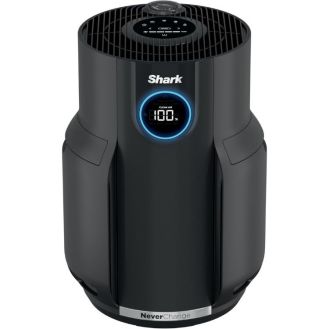
Shark HP152 Air Purifier
Easiest to Maintain
Area covered: 650 sq ft | Filter type: HEPA | Dimensions: 10.47" L x 9.33" W x 14.9" H | Weight: 7.3 lb
The Shark HP152 Air Purifier is a perfect option if you don’t want to deal with complicated or expensive maintenance. It features a NeverChange HEPA filter as part of its filtration system that can last up to five years and save you up to $150 on replacement filters over that period. The filtration system still captures up to 99.98% of large, small and microsized allergen particles, providing top-notch air cleaning.
Trapping large particles won’t clog this air purifier, though. It features Debris Defense Protection technology that prevents large pieces of hair, dust and dander from building up on the HEPA filter, maintaining its air-cleaning performance. Cleaning the filters is as easy as removing the screen and vacuuming, wiping and rinsing, which takes less than a minute.
While it’s a small, compact model, the HP152 can still clean up to 650 square feet in just an hour. That makes it perfect for a bedroom, nursery, home office or even a dorm room. It has a sleep mode, too, which reduces its noise level and dims its control lights, so you can sleep without interruption.
Winix 5510 Air Purifier
Best Smart Air Purifier
Area covered: 1,881 sq ft | Filter type: HEPA | Dimensions: 11" L x 15.9" W x 25.2" H | Weight: 13.3 lb
If you love the convenience of smart-home devices, you’ll definitely appreciate the WINIX 5510 Air Purifier. It features smart sensors and an auto mode that measure your home’s air quality and adjust its speed as needed. You can also use the WINIX Smart App to monitor and control the air purifier remotely, ensuring your home’s air is always clean.
The 5510 can clean up to 1,882 square feet in just an hour, so it can work wonders even in larger rooms. Its true HEPA filter allows it to trap up to 99.99% of airborne particles as small as 0.01 microns, including pollen, dust and smoke. It helps control household odors and reduce VOCs, too.
If you plan to place it in a bedroom, it also features Sleep mode. Its speed is reduced, lowering its noise level to just 23.5 decibels and enabling more energy-efficient operation. It also dims the control panel’s lights when the room is dark and then switches back to Auto mode when the light increases.
Dyson HushJet Compact Purifier
Most Powerful
Area covered: 203 sq ft | Filter type: Electrostatic | Dimensions: 9.06" D x 9.06" W x 18.5" H | Weight: 6.9 lb
When you want a powerful air purifier without all the noise, the Dyson HushJet Compact Purifier is a winner. Almost nothing can escape this small but mighty machine’s 360-degree electrostatic filter, which captures 99.7% of pollutants as miniscule as 0.3 microns.
Dyson is well-known for its exceptional engineering, and this purifier’s noise-reducing star-shaped nozzle is more evidence of that. It dampens the whirring of the motor down to 24 decibels when put in sleep mode. Additionally, the body of the machine is fully sealed, so all those dust particles and pollutants stay trapped inside.
When you’re away, you can still control the machine via the MyDyson app. It lets you set a schedule for running it, alerts you when the nonwashable filters need to be replaced and even sends you air-quality reports. The Dyson HushJet also features an activated carbon filter to take care of odors from cooking or pets, ensuring your air smells fresh and clean, too.
Other air purifiers we considered
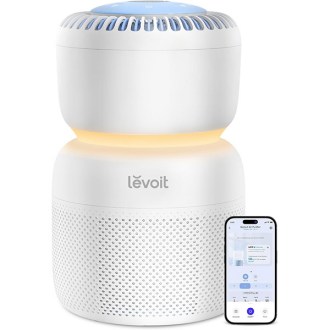
Levoit Air Purifier for Baby with White Noise Sound Machine
Best for Everyday Use
Area covered: 639 sq ft | Filter type: Advanced true HEPA filter| Dimensions: 8.7" L x 8.7" W x 14" H | Weight: 6.4 lb
Designed specifically for children, the Levoit Air Purifier for Baby with White Noise Machine provides parents with confidence that the air in their little one’s room is clean.
It features five sensors that monitor air quality and remove airborne contaminants, such as dust, pollen, smoke and viruses, via its advanced true HEPA filter. The sensors measure seven air factors, including total volatile organic compounds (TVOC), carbon dioxide, temperature and humidity, so you can better understand your child’s sleeping conditions.
This air purifier is powerful enough to clean the air in spaces up to 639 square feet once per hour, making it ideal for nurseries and children’s bedrooms. In addition to keeping the air in your baby’s sleeping environment clean, it has a soft, warm night light to help children sleep peacefully. Its white noise feature can also help your baby drift off and stay asleep throughout the night. You can even use the VeSync app to adjust settings from your smartphone, so you don’t have to disturb your child by making manual adjustments.
Blueair Blue 311 Air Purifier
Area covered: 388 sq ft | Filter type: Pre-filter, carbon filter and HEPASilent filter | Dimensions: 10.2" L x 10.2" W x 20.5" H | Weight: 6.8 lb
The Blueair Blue 311 Air Purifier has a stylish fabric prefilter that comes in a choice of subtle colors and an intuitive single-button control. Beneath its simple chassis is a powerful air purifier with a smoke CADR of 250 CFM, which can fully exchange the air in a 388-square-foot room every 12.5 minutes, or 4.8 changes per hour (a standard measure for air purifiers).
The soft fabric prefilter captures pollen and dander, while the HEPA and activated carbon filters remove 99.97% of PM2.5 and absorb VOCs and cooking odors. It boasts three speeds and a sensor-based automatic mode, while an LED indicator light changes color when it detects bad, medium or good air quality.
Sleep mode turns off all the device’s lights and reduces the noise level to a low 23 decibels (dB). Replacement filters cost around $25 for every six months of 24/7 use.
Medify Air Purifier
Area covered: 825 sq ft | Filter type: True HEPA filter | Dimensions: 8" L x 8" W x 13.5" H | Weight: 7.3 lb
The Medify, available singly or in a two-pack, is another great air purifier that can clean the air in a 500-square-foot room twice in an hour. Slightly smaller than the Levoit, it can live on a tabletop or side table, but its dual filters give it the power and coverage of the Blueair with a similar CADR of 250.
Each of its two filters has a prefilter, HEPA H13 filter and activated carbon filter, and the three-speed fan can run as low as 25 dB, so it won’t disturb your sleep. The Medify has a sleek touch panel control and display and looks good in your home.
The filters cost $50 for two and should be replaced every three to four months of continuous use.
AirDoctor AD3500
Area covered: 630 sq ft | Filter type: Ultra HEPA filter and dual action carbon VOC filter | Dimensions: 15.75" L x 8.35" W x 23" H | Weight: 18 lb
The classic AirDoctor AD3500 has a CADR of 336 and can achieve four air exchanges an hour in a spacious 630-square-foot area like a combined living/dining room.
AirDoctor promotes its proprietary “UltraHEPA” filter, which claims to trap particles down to 0.003 microns, a hundred times smaller than PM2.5. AirDoctor also promotes its carbon/gas trap combo filter that captures odors and VOCs including formaldehyde.
AirDoctor has four models to choose from for small to large spaces. Depending on which model you choose, the special filters cost $45 to $125. The combo carbon/gas/VOC filter needs changing every six months of continuous use, and the UltraHEPA filter should be swapped once a year.
Expert tip
Mark your calendar for a weekly washing of pre-filters. Doing so adds to the longevity of HEPA and carbon-activated filters.
BestReviews Home Improvement and DIY Expert
How we tested
The BestReviews Testing Lab reviews products in real-world usage. For this buying guide, we bought the Levoit Air Purifier for Home and examined it based on the following criteria.
First impressions
- Setup: We noted the setup process from opening the packaging to the first use. We graded it on difficulty, number of steps, technical knowledge required and whether it would be simple for the average person.
- Product quality: We evaluated the product’s look and feel, aesthetic appeal and quality of its materials and construction.
Operation
- Air quality: This is the most important feature. We set up the unit in different rooms and ran it 24 hours a day, seven days a week, to see if it made a perceptible difference in air quality.
- Room size: We used the unit in rooms of different sizes to see how well it performed at its rated square footage and higher.
- Fan speed: We operated the unit at all the fan speeds it offers and noted its performance at each level.
- Noise level: We noted how loud the unit was at various fan speeds and whether or not it would interrupt sleep or conversation.
- Ease of use: We observed how easy the controls were to understand and use, including any smart apps or assistants, as well as timers and automatic on/off.
Maintenance
- Filters: We checked the price of replacement filters and how simple or difficult it was to change them.
Key features to consider
Room size
If you want your home’s air as clean as possible, an air purifier has to be powerful enough for the size of the room it's in. In most cases, you want it to clean the entire space several times per hour. You can tell how powerful a model is by noting several key figures, including its CADR (clean air delivery rate), CFM (cubic feet per minute) and ACH (air changes per hour).
CADR measures the volume of clean air that an air purifier produces in CFM. Some models provide the CADR for specific pollutants, such as dust, pollen and smoke. The higher an air purifier’s CADR, the faster it can clean the air. For example, an air purifier with a CADR of 350 is more efficient than a model with a CADR of 250. While most manufacturers provide CADR based on a single air change per hour, the most effective air purifiers provide between 3 and 4 ACH.
You can’t always trust the square footage coverage that manufacturers provide, though, so a good rule of thumb is to choose an air purifier with a CADR rating that’s at least 2/3 of its size. For example, if your room is 360 square feet, choose a model with a CADR of 240 CFM.
Filter types and replacement filters
Most air purifiers use multistage filtration systems to remove as many pollutants and particles as possible from the air. Some of the most common filters used include:
- True HEPA: You’ve probably heard of a HEPA — or high-efficiency particulate air — filter, which is generally considered the highest-quality filter available. A true HEPA filter is independently tested and certified to capture 99.97% of particles as small as 0.3 microns, so an air purifier with this type of filter typically provides the cleanest air.
- Activated carbon: An activated carbon filter is effective at trapping odors, smoke, volatile organic compounds (VOCs) and gases rather than particles. These gaseous particles stick to the outside surface of the filter through a process called adsorption, removing them from your home’s air.
- Washable pre-filters: Pre-filters are usually the first line of defense in an air purifier. They trap larger particles like pollen, pet hair and dust, which helps the HEPA filter last longer. These pre-filters are usually washable, so you can clean them with a vacuum and rinse them in a sink to remove the particles that build up on their surface.
- UV light filters: Some advanced air purifiers feature UV light filters, which typically use UV-C light to kill bacteria and viruses. Some can also neutralize mold spores. However, they need several seconds to kill germs, and air passes through a purifier so quickly that there’s some question about their effectiveness.
With the exception of pre-filters, which are typically washable, all other air purifier filters have a limited lifespan and must eventually be replaced. The lifespan depends on the type of filter and the levels of particles and pollutants in your home’s air, but most filters generally last a few months. Keep in mind that even washable filters may need to be replaced over time, though they usually last for years instead of months.
Noise and energy efficiency
Because you’ll usually run an air purifier 24-7, you’ll want a model that doesn’t make too much noise or use too much energy. Many models include the decibel level at which they operate, so you can get an idea of how loud they will be. Most top out at approximately 50 to 55 decibels, which is similar to the volume of quiet conversation. However, most have a Sleep setting that operates at a lower speed, so they can get as low as 30 to 40 decibels, equivalent to a whisper or a refrigerator’s hum.
To ensure your air purifier is as energy-efficient as possible, choose a model that’s earned Energy Star certification. These air purifiers are approximately 40% more efficient than standard models, so you can save money by running them around the clock.
Smart features
Some air purifiers offer smart features that make their operation more convenient or efficient. Many smart models have a companion app that lets you remotely adjust their settings on your smartphone or other connected device. You can often check your home’s air quality via the app and receive alerts when it’s time to change or wash filters.
Additionally, some air purifiers feature smart sensors that monitor your home’s air quality. They then automatically adjust the unit’s speed to ensure your home’s air stays as clear as possible.
Tips for using an air purifier
- Run the air purifier at top speed for an hour. For best results, run your air purifier at its maximum speed for 60 minutes to make a real difference in a room. Afterward, you can switch it to a lower fan speed, but keep it running continuously for the best air quality.
- Keep the space clear around the air purifier. For the best performance, place the air purifier as close to the center of the room as possible. Some devices work well on the floor, while others work better on a table. Give the air intake enough clearance to draw in air, avoiding curtains, pillows and other items that may block the airflow.
- Clean the prefilter. The prefilter catches the pet hair, dust bunnies and other large particles before they reach the other filters. Regularly vacuuming or washing the prefilter extends the life of the other filters and keeps the air purifier running efficiently.
- Avoid filters labeled “HEPA-type.” Some brands use the term “HEPA-type” to refer to filters that act like HEPA filters but don’t actually meet the HEPA specification of the U.S. Department of Energy. Those that do meet the official HEPA spec are marketed as “True HEPA” filters, although that isn’t an official term.
Expert tip
Consider ordering filters in bulk if possible to save money.
BestReviews Home Improvement and DIY Expert
FAQ
Q. How much do air purifiers cost?
A. Home air purifiers cost anywhere from $50 to $1,000. However, air purifiers that cost less than $100 are either too small or can be of poor quality from less reputable manufacturers. Good air purifiers from reputable brands, with solid CADR numbers and realistic square foot coverage, cost $100 to $400. The range of $200 to $250 is the sweet spot for size and performance. It’s a good idea to find out how much the replacement filters cost, and how often they need to be changed. Manufacturer recommendations are typically based on running an air purifier continuously 24 hours a day, seven days a week.
Q. Do air purifiers really work?
A. Air purifiers really work for what they’re designed to do. According to the EPA, “research shows that filtration can be an effective supplement to source control and ventilation,” and that a “portable air cleaner with a high CADR and an activated carbon filter can filter both particles and gasses.” However, the EPA also emphasizes that “no air cleaner or filter will eliminate all of the air pollutants in your home.” Ventilating with fresh outdoor air and removing sources of pollution are always recommended first, whenever practical.
Q. Is it worth getting an air purifier?
A. If you live in an area that frequently enjoys fresh outdoor air and your home is well ventilated, you may not need an air purifier or need to run one continuously. However, if you live in an area vulnerable to air pollution, including cities, near major roads or airports or in areas downwind of wildfire, you probably need an air purifier, especially when the outdoor air quality index (AQI) is poor. Pet owners also will benefit from using a pet vacuum in addition to an air purifier. If you have health concerns related to breathing or lung disease, an air purifier may help.
Q. Can I use an air ionizer instead of an air purifier?
A. An air ionizer can help reduce the number of particulates in the air and may help with some airborne germs. However, it won’t actually remove the particulates unless it has some sort of air purifier components, like a fan and filter. Some air purifiers do have an ionization function.
Q. Can I use an ozone generator instead of an air purifier?
A. No! Ozone (O3) is helpful in the stratosphere to block ultraviolet rays, but at ground level, it’s a harmful pollutant. Ozone generators are sometimes used by professionals, for example, to remedy smoke damage from a fire, but ozone by itself does nothing about particulate matter or other pollutants. According to the EPA, you should never stay in the same room as an ozone generator.